[ad_1]
✕
Upon the recent opening of the new Conde M. Nast Galleries at the Metropolitan Museum in New York, and the inaugural exhibition Costume Art, two well-established architects were overheard griping. Their reproach maintained that this was the beginning of the end for the stature of art museums. “It started with the Armani show at the Guggenheim in 2000,” claimed one. “And placing galleries focusing on fashion next to the Grand Hall at the Met means it’s the first department you see as you come in,” noted the other. We won’t name these two critics, just in case Met director and CEO Max Hollein might have them on his RFP list for a future renovation/expansion. In the last few years, Hollein, the highly reputed museum head who is also the son of the prominent Austrian architect Hans Hollein, has been hiring emerging architects to renovate various curatorial departments—Frida Escobedo, Kulapat Yantrasast of WHY, and Nader Tehrani of NADAAA among them.

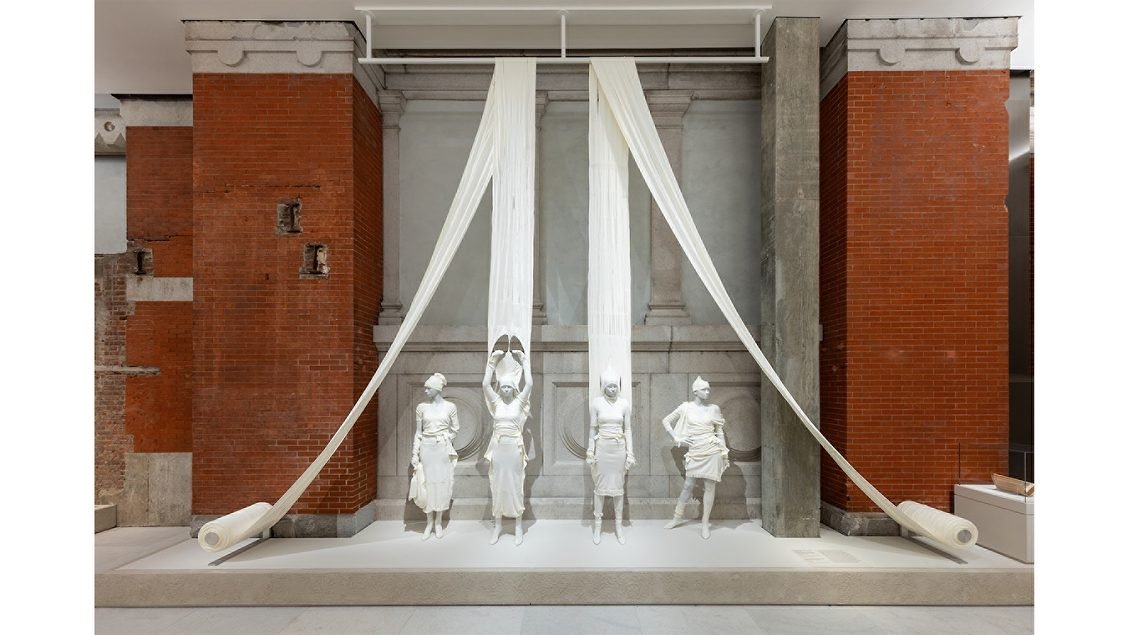
The Miyake Design Studio installation stands in front of the rear wall of the High Gallery marked by traces of historic remnants of the Met’s earlier structures. Photo © Nicholas Calcott
Now the 12,000-square-foot Conde M. Nast Galleries, designed by the young firm of Peterson Rich Office (PRO) in Brooklyn, provides yet another significant architectural component to that list. Nevertheless, with two costume-gallery areas at the Met—the existing Anna Wintour Costume Center in the basement plus the more visible new cluster on the main floor—fashion, called by its more sober-serious name, “costume,” has arrived at an enviable place in the Met’s curatorial spectrum. The museum director’s father, Hans, famously said, “Alles ist Architecktur” in 1968. Some architectural skeptics wonder if his son’s latest move is shifting that maxim to “All is fashion” at the Met. Certainly, the inaugural exhibition, Costume Art, on view until January 10, 2027, underscores the connection of clothing, dress, fashion—whatever you call it—to the more glorified world of art, what with 200 pieces on view from other departments.
The Galleries
To their credit, 2018 Design Vanguards Miriam Peterson and Nathan Rich have given the museum a discreet, hushed, elegant setting. With new materials, such as warm gray marmorino-plastered walls and light gray quartzite floors, it incorporates parts of the old Met’s structure to create a flexible but quiet backdrop for exhibitions to come. The Conde M. Nast Galleries, inserted into the shop, originally had been an open courtyard adjoining the Met’s first museum building, a Ruskinian Gothic affair designed by Calvert Vaux and Jacob Wrey Mould in 1880, and also adjacent to the extension by Theodore Weston and Arthur L. Tuckerman in 1888. The newest galleries are entered by the Great Hall, created by Richard Morris Hunt in 1902, when Hunt’s beaux arts addition became the main facade for the Met.
As visitors walk through the Great Hall, they arrive at the Conde M. Nast Orientation Gallery via 18½-foot-high portals framed in Indiana limestone. From there, large oak doors admit visitors to the High Gallery, a luminous expanse with a 21-foot-tall ceiling. Infrastructural beams containing HVAC, sprinklers, and fixtures for uplighting traverse the room. To keep the light level at 5 foot-candles, owing to the sensitivity of the fragile costumes and delicate art objects, PRO used indirect illumination and discreet spots, all 3000K LEDs. For the current exhibition, the firm installed translucent scrim to partition exhibited works in freestanding display cases, so that sight lines can be maintained throughout, in an ethereal way. Wood vitrines painted warm gray contain artworks positioned within 6-foot-high platforms that sit atop a 12-inch-high rusticated plaster base; atop the platforms are mannequins wearing costumes selected for the current exhibition.

The Entrance Portal into the High Gallery. Photo © Nicholas Calcott
Off to the side are the Low Galleries, designated for more intimately scaled pieces. As visitors weave through the 4,750-square-foot space, they come back into the High Gallery, where the back wall reveals slightly decayed traces of brick and granite pertaining to the older edifices. The combination of contemporary and historic remnants forms a dramatic concluding note to the trajectory; visitors may proceed either to a small shop selling Costume Art catalogues or to the other side, where oak-paneled doors lead to the Byzantium rooms.
The Exhibition
Peterson and Rich are particularly fortunate in being assigned the installation design in addition to their gallery conversion, especially since the newly renovated space of the Costume Institute would open at the same time as the much ballyhooed 2026 Met Gala. Above all, the Met, and Costume Institute curator in charge Andrew Bolton, want to emphasize the timeless connection between clothing and art and investigate the way couture reflects and is reflected by “portraiture, material history, and the way identity has been constructed over time.”

Abstract Body, with dresses by Worth and Bobergh and House of Dior. The painting is by Franz Xaver Winterhalter (1859). Photo © Anna-Marie Kellen/The Metropolitan Museum of Art
This pronouncement brings to mind Worth: Inventing Haute Couture, an exhibition devoted to the House of Worth mounted in the summer of 2025 in Paris’s Petit Palais. It proved to be an illuminating integration of social culture, biography, painting, and photography with fashion. The Met show does not quite go in that direction. The clothing connected to the art here is more inclusive, not too haute. And it seeks an intellectual grounding based on the “body.” As Bolton says: “I wanted to focus on the centrality of the dressed body within the museum, connecting artistic representations of the body with fashion as an embodied art form.” OK, we get it.
So, in addition to the vaunted artistic lineage, Costume Art presents varied themes of fashion design based on body types—not only the classically proportioned dress design traditionally accepted in the West, but also clothing for the “pregnant, corpulent, and disabled,” long given the cold shoulder in the world of fashion as well as museum exhibitions, and, with rare, recent exceptions, magazines.

Classical Body. Photo © Anna-Marie Kellen/The Metropolitan Museum of Art

Pregnant and Corpulent Body in the High Gallery. Photo © Anna-Marie Kellen/The Metropolitan Museum of Art
Granted, a good part of the show legitimately tries to make the human body somewhat comfortable and proud of itself—even to have dignity. The sections on the Classical Body (e.g. fashion inspired by Greco-Roman statues) and the Abstract Body (e.g., showing couture with crinolines) are good examples, and the mannequin heads with flat, mirrored faces designed by artist Samar Hejazi blend in well. Although a lot of effort and research went into creating an exhibition that would appeal to a wide audience, is the show successful in its mission? In so many cases, these “embodied” concoctions are uncomfortable, not easy to wear or sit it in…. and without dignity, only shock. And speaking of reaching everyone, I should be able to relate to the section on the Aging Body. I have that problem. So maybe it’s heartening to read the exhibition label: “The dressed aging body is caught in a dialectic between aesthetic presence and social erasure.” But when I look at the designs by Harry Pontefract (“Legs” or “Stockings,” 2025) and compare them to Sarah Lucas’s sculpture Nud Cycladid 9 (2010) I don’t think I have found my identity. Nor could I possibly wear those sausages without feeling socially erased. I’m not sure this outfit could help me radiate a smidge of an aesthetic presence. Enough said, but there are more examples.

Aging Body section has designs by Harry Pontrefract (“Legs” and “Stockings,” 2025) on either side of Sarah Lucas’s sculpture Nud Cycladid 9, 2020). Photo © Anna-Marie Kellen/The Metropolitan Museum of Art
The good news is that a new shop and dining facilities are planned for the basement (aka ground floor) of the Met at the 83rd Street entrance. And PRO, working with Beyer Blinder Belle as executive architects, is also designing this new space near the existing Costume Institute. So “All is Architecture” at the Met, even if Fashion gets its pride of place…for now.
[ad_2]
Source link