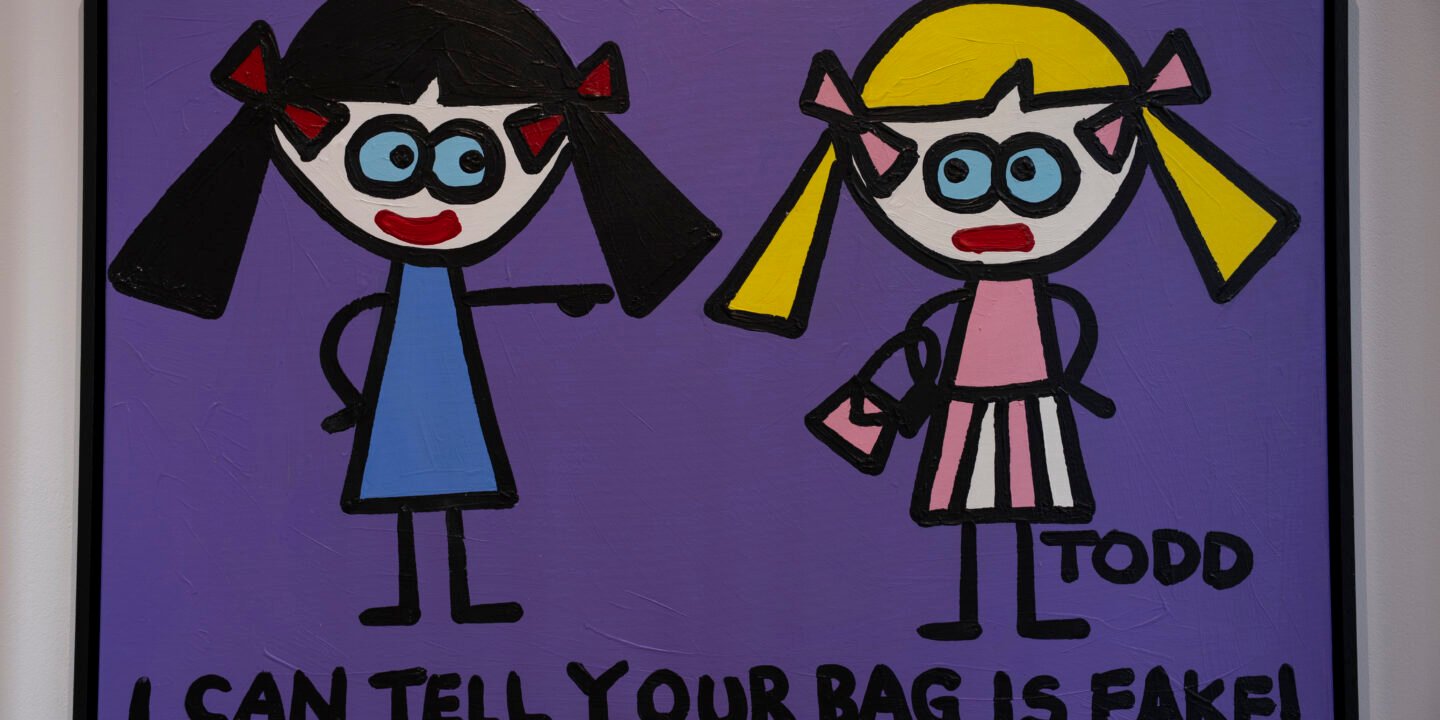
Todd Goldman art is built around an idea that sounds simple but is difficult to execute: help the viewer understand an image immediately, then give that viewer a reason to look again. The apparent innocence is rarely the whole story. A short phrase, an unexpected relationship or a deliberately awkward observation changes the image and turns the first smile into a second thought.
Goldman describes himself as a professional doodler. The phrase is humorous, but it also explains the discipline behind his work. Doodling is normally associated with distraction, spontaneity and unfinished ideas. Goldman treats it as a finished visual language. He removes unnecessary detail until a character, object or emotion can be recognised through a handful of marks. What appears casual is supported by an understanding of timing, proportion and visual memory.
His work belongs to a world in which images compete for attention. A complicated picture may ask for patience, but a Goldman character announces itself quickly. The viewer does not need specialist knowledge to identify an ice cream cone, a dog, a child or an unhappy couple. This directness has allowed his imagery to function across paintings, books, clothing and other formats without losing its identity.
Why Todd Goldman Art Looks So Simple
Simple drawing is often misunderstood as easy drawing. A line that is too heavy changes a face. A misplaced dot alters an expression. A colour that is too quiet weakens the joke. Goldman’s figures depend on a small number of elements, so each element has to communicate clearly.
The faces are frequently built from dots, circles and a curved line. Bodies can be reduced to basic silhouettes. Objects are outlined in black and separated from backgrounds filled with strong colour. This gives the work the visual confidence of a sign or poster. It can be read from across a room, yet the painted surface and irregular marks become clearer when the viewer moves closer.
From a distance, the picture behaves like a graphic statement. Up close, it becomes a physical painting. Texture, brushwork and small variations remind the viewer that the object was made by hand. The difference between a reproduced design and an original canvas becomes visible through material presence rather than through the image alone.
When Words Become Part of the Picture
Goldman does not treat language as an explanation placed beneath an image. The words are part of the composition. Their scale, position and rhythm influence how the viewer reads the work. In many paintings, the sentence delivers the final turn, but the drawing prepares the audience for it.
This technique resembles the structure of a short joke. The image establishes the subject. The phrase changes its meaning. The response depends on timing, recognition and surprise. Because the language is brief, there is little space for uncertainty about the intended punchline. The viewer may enjoy it, reject it or feel uncomfortable, but indifference is less likely.
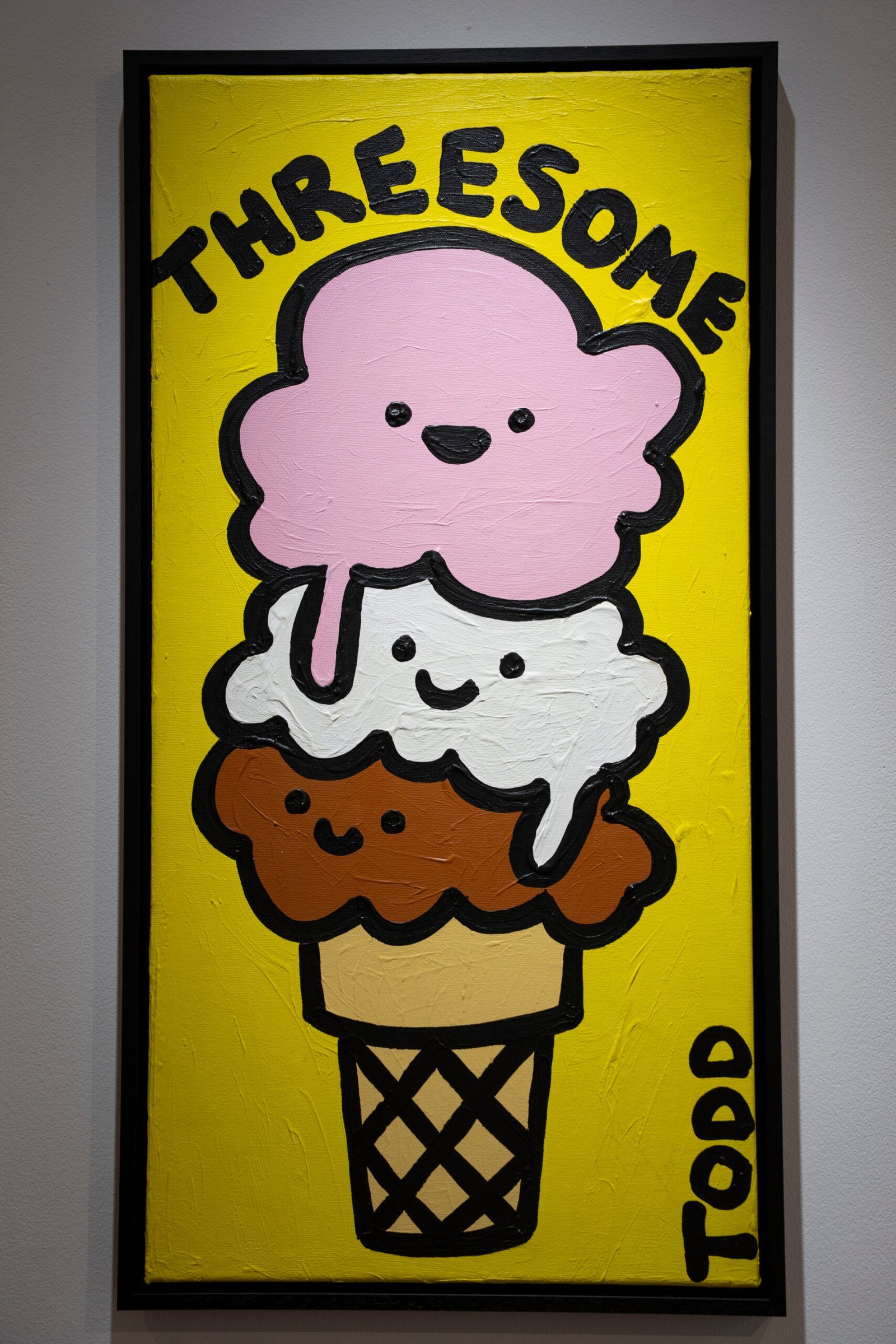
One photographed work shows three smiling scoops of ice cream stacked above a cone. The word Threesome appears above them. Without the word, the painting could be a cheerful food illustration. With it, the innocent characters acquire an adult implication. The joke exists entirely in the collision between the appearance of the figures and the association created by the title.
Another photographed painting presents a child throwing rocks beside the phrase Boys Are Stupid, Throw Rocks at Them. The design is one of Goldman’s most widely recognised images. Its deliberately juvenile appearance intensifies the provocation of the sentence. It also demonstrates how his work can divide audiences. Some see exaggerated humour and nostalgia. Others see a gendered message that has aged poorly or crosses a line.
Goldman’s art does not resolve that argument for the viewer. Its method depends on creating a reaction quickly enough that the audience must decide where it stands.
Humour Drawn from Adult Life
Although the characters often look childlike, the subjects commonly belong to adulthood. Goldman draws on relationships, attraction, vanity, insecurity, frustration, social embarrassment and the strange rules people create for themselves. The visual language softens these subjects without completely removing their edge.
That contrast gives the paintings their particular tone. A more realistic image might make the same sentence appear aggressive or cynical. A simplified smiling figure creates emotional distance. The audience is invited to recognise a familiar weakness while remaining inside the safety of a cartoon world.
Humour also allows Goldman to approach ordinary experiences that traditional portraiture or narrative painting might overlook. Minor annoyances, embarrassing thoughts and bad decisions become worthy subjects. The work suggests that popular culture is shaped not only by major events but also by the private jokes people repeat to friends and the phrases that become shorthand for shared experiences.
This is one reason his imagery has travelled easily. The work does not require a lengthy explanation before it can be shared. The idea survives changes in scale and setting because the central relationship between picture and sentence remains intact.
Characters That Refuse to Stay in One Medium
Goldman’s career includes recurring characters as well as isolated jokes. Publishing gave those figures space to develop beyond a single image. His credited books include Bear in Underwear, Rawr, Super Fly, Hot Rod Hot Dog and Hound Heroes. Publisher biographies have presented him as both an artist and a creator of humorous worlds for younger readers.
A character operates differently from a slogan. It can return, encounter new situations and acquire habits. Readers develop recognition over time. This encourages a form of attachment that is less dependent on one punchline and more connected to personality.
The ability to move between formats is central to Goldman’s practice. A painting offers scale and material texture. A book provides sequence and narrative. A product places the image in everyday life. These forms are commercially different, but they can originate from the same compact visual idea.
For some observers, that movement complicates his position in fine art. Commercial visibility can make an artist famous while also causing critics to treat the imagery as branding. Goldman’s work sits directly inside that tension. It does not pretend that popular products, publishing and gallery paintings exist in separate creative universes.
An Artist Shaped by Audience Response
Goldman’s official biography says that his goal is to make people laugh. That objective places audience response at the centre of the work. The success of a painting is not measured only by formal innovation. It is also measured by whether the image connects, whether the joke lands and whether the character remains memorable.
This approach challenges the assumption that accessible art must lack seriousness. Accessibility is itself a creative problem. An artist has to decide what can be removed without weakening the idea, how quickly the subject should be recognised and how much ambiguity the audience can absorb before the moment is lost.
Goldman’s solution is usually compression. He reduces an observation to a character and reduces the character to a few decisive lines. Colour directs attention. Language supplies the twist. The finished image behaves almost like a visual headline, but its handmade surface preserves the individuality of the object.
The same accessibility also exposes the work to immediate judgement. When an image is direct, the artist cannot hide behind obscurity. Viewers understand enough to form an opinion at once. Goldman’s work has attracted enthusiasm, criticism and controversy precisely because people rarely need help deciding how it makes them feel.
The Value of an Uncomplicated Encounter
Contemporary art can sometimes make viewers feel that they need permission, education or specialised language before responding. Goldman’s paintings offer a different kind of encounter. Recognition comes first. Interpretation follows if the viewer wants it.
This does not mean every painting carries a hidden philosophical argument. Their strength often lies in refusing unnecessary complexity. A joke can remain a joke while still revealing something about taste, relationships or the limits of what an audience considers acceptable.
The most useful way to approach the work is therefore neither to dismiss it as merchandise nor to inflate it into something it does not claim to be. Goldman is an artist of immediacy. He works with familiar objects, blunt language and emotional recognition. His pictures seek attention openly and reward viewers who understand the cultural references behind their simplicity.
His current association with London Art Exchange brings this practice into a renewed United Kingdom gallery context. The relationship offers British audiences another opportunity to encounter original paintings as physical objects rather than only as reproduced images. It is a short new chapter in a much larger creative story.
Todd Goldman’s work asks a direct question: can a picture be simple, funny, commercially recognisable and still deserve careful attention? His career still suggests that these qualities do not have to cancel one another. The doodle can be a joke, a character, a product and a painting. Its seriousness lies in how deliberately it knows the difference.