[ad_1]
By noon on preview day at Frieze New York, the escalators inside the Shed had once again become one of the fair’s defining stages. Packed shoulder to shoulder with collectors, artists, editors, celebrities, and impeccably dressed fairgoers moving quickly between floors with iced coffees, oversize tote bags, and phones in hand, the towering escalators offered a sweeping view of the social choreography unfolding below. Long lines formed outside some of the fair’s busiest galleries as guests spent much of the afternoon weaving through crowds to move from booth to booth. After weeks of unusually cold spring weather in New York, the sun finally broke through by early afternoon as a line of black Escalades idled outside the Hudson Yards venue. Conversations about major acquisitions mixed with dinner plans, exhibition gossip, and after-party logistics while crowds spilled into the aisles.
“It was a packed first day, as ever, and this year the art gave people a reason to stop rather than just circulate,” says Rachael Lambert, an art dealer and director of Lion and Lamb Fine Art. “The performative machinery of the art world was on full display; opening day drew the largest crowd I’ve seen in years. The art, to its credit, offered something worth the theater. The conversation around materiality has genuinely shifted, with more diversity than ever before. The best work on the floor this year simply assumed its own authority. What emerged felt less like a trend and more like a field mid-evolution.”
Now in its 16th New York edition, Frieze remains one of the city’s most influential and highly attended art fairs, anchoring the frenzy of New York’s spring art season each May. The fair has evolved considerably since its early years on Randall’s Island, when visitors arrived by ferry and the journey itself became part of the mythology. Since relocating to the Shed following the COVID pandemic, Frieze has taken on a sleeker and more distinctly Manhattan energy, where fashion, art, and social spectacle increasingly blur together. This year, more than 65 galleries from across the globe filled the Shed, reflecting the increasingly international direction of contemporary art. A particularly strong presence of Latin American artists could be felt across the fair, shaped in part by the addition of gallery committee members Fátima González of Campeche and Omayra Alvarado of Instituto de Visión. Textile-based pieces, sculpture, and works on paper surfaced across many of the strongest booths, signaling a broader shift toward materiality, craft, and more tactile forms of presentation.
Upstairs, the Ruinart Art Lounge quickly became one of the fair’s busiest gathering points, with guests crowding the space between champagne pours and conversations drifting late into the afternoon. This year, preparatory studies by Japanese artist Tadashi Kawamata, tied to his forthcoming permanent installations at Ruinart’s historic home at 4 Rue des Crayères in Reims, added a sculptural and atmospheric dimension to the lounge. Set against the fair’s constant movement below, the works introduced a quieter, nature-driven sensibility into one of Frieze’s most socially charged spaces.
Notable sightings during the opening included Leonard DiCaprio and gallery owner Almine Rech, alongside celebrity art adviser and Sotheby’s senior vice president Ralph DeLuca, who moved briskly between booths throughout the afternoon preview.
Beyond the social frenzy, this year’s fair ultimately felt strongest at the booth level. Many exhibitors leaned into tighter and more focused presentations that balanced internationally established artists with younger voices and emerging talent. While several mega-galleries drew steady crowds throughout the day, some of the most compelling moments came from booths that rewarded slower looking rather than instant spectacle.
The Focus section—which highlights galleries that have been operating for 12 years or fewer through solo artist exhibitions—was especially strong this year and offered some of the fair’s sharpest presentations. From large-scale environments to quieter works that stopped viewers in their tracks, these were the booths that stood out most at Frieze New York 2026.
Southern Guild, Booth D07
The Los Angeles and Cape Town-based gallery Southern Guild arrived at Frieze this year with added momentum following the recent opening of its Tribeca location in New York. Founded in 2008 by husband and wife Trevyn and Julian McGowan, the gallery has become known for championing artists from across the African continent and diaspora through exhibitions that blend material experimentation with deeply personal storytelling. For the 2026 edition of Frieze, Southern Guild presented one of the fair’s strongest group booths, bringing together five artists whose practices explored labor, memory, ritual, and representation across painting, sculpture, and installation.
“Frieze New York feels like a defining moment for the kind of conversation Southern Guild has always wanted to foster in New York,” says Trevyn McGowan, co-founder of Southern Guild. “[This] presentation brings together artists whose work carries real material presence, emotional depth, and conviction. To see this work resonate with such a sophisticated, globally minded collector base, just weeks after opening our Tribeca space, feels deeply meaningful and makes it clear that something is truly taking root.”

Southern Guild, Booth D07, at Frieze New York 2026.
Among the standouts were paintings by Manyaku Mashilo, whose practice draws on historical archives and photographic imagery to construct dreamlike scenes suspended somewhere between memory and fantasy. The large unframed canvases immediately commanded attention within the booth. Rendered in lush color and soft atmospheric light, Mashilo’s figures drifted through celestial landscapes filled with rich blues, warm earth tones, and flashes of gold. While the paintings drew on elements of photorealism, her ethereal palette and layered compositions pushed the works into a distinctly contemporary direction, giving them an almost Afrofuturist quality.
Nearby, Roméo Mivekannin’s monumental paintings similarly reimagined the history of Western portraiture through a contemporary lens. Featuring Black figures that often resemble the artist himself, the works inserted new narratives into familiar historical imagery while confronting longstanding questions surrounding visibility and representation. Their large scale and photorealistic surfaces gave the paintings an immediate physical presence inside the booth, though the emotional and conceptual weight of the works unfolded more slowly over time.
Instituto de Visión, Booth D09
Instituto de Visión presented one of the fair’s most visually arresting booths, transforming its corner of the Shed into a quieter and more atmospheric environment amid the constant movement of the fair. The Bogotá-based gallery brought together seven artists exploring ecology, inherited histories, and sound through sculpture, textile, and installation.
Among the standouts were Carolina Caycedo’s woven sculptural works “Cangrejo sabanero” and “Rana sabanera,” basket-like forms suspended from the walls that appeared somewhere between ceremonial objects and organic marine life. Their intricate handwoven textures, curved silhouettes, and earthy tones introduced a softness that contrasted with the sharper architectural lines of the surrounding booths.

“Cangrejo sabanero” by Carolina Caycedo.
Nearby, Mexico City-based artist Tania Candiani presented “Prosperidad y abundancia,” a sound sculpture that subtly transformed the atmosphere of the space itself. Layered sounds echoed quietly throughout the booth, slowing viewers down as they moved through the installation. Together, the presentation reflected the growing presence of Latin American artists at Frieze this year while underscoring larger conversations around craft, materiality, and sensory experience unfolding across many of the fair’s strongest booths.
Night Gallery, Booth K11
The Los Angeles-based Night Gallery dedicated its booth to a solo presentation by artist Hayley Barker, featuring a new body of large paintings created following a five-day equine therapy retreat in the American Southwest.
“The response to Hayley’s work at Frieze has been overwhelmingly positive,” says Davida Nemeroff, the owner of Night Gallery. “Our booth installation of this beautiful new body of work transports us away from the Shed and into the American Southwest. They’re beautiful paintings, and it’s exciting to give New Yorkers a chance to see them in person.”

“Tamarisk” by Hayley Barker.

“Stella” by Hayley Barker.
The booth immediately stood out for its saturated palette, glowing desert light, and cinematic atmosphere. Barker’s paintings draw on the mythology and visual language of the Southwest, with expansive skies, horses, organic forms, and warm amber tones unfolding across monumental canvases.
Anchoring the booth was an expansive 11-foot painting depicting a glowing late afternoon sun filtered through the branches of a tree. Rendered in rich golds, burnt oranges, and deep shadow, the painting radiated outward into the aisle, pulling viewers toward it throughout the afternoon. Elsewhere, horses emerged repeatedly throughout the presentation, becoming vehicles for larger meditations on instinct, vulnerability, intimacy, and the emotional relationship between human and animal consciousness. Amid the pace and visual overload of the fair itself, the booth offered one of Frieze’s most transportive and emotionally charged environments.
Andrew Kreps Gallery, Booth A01
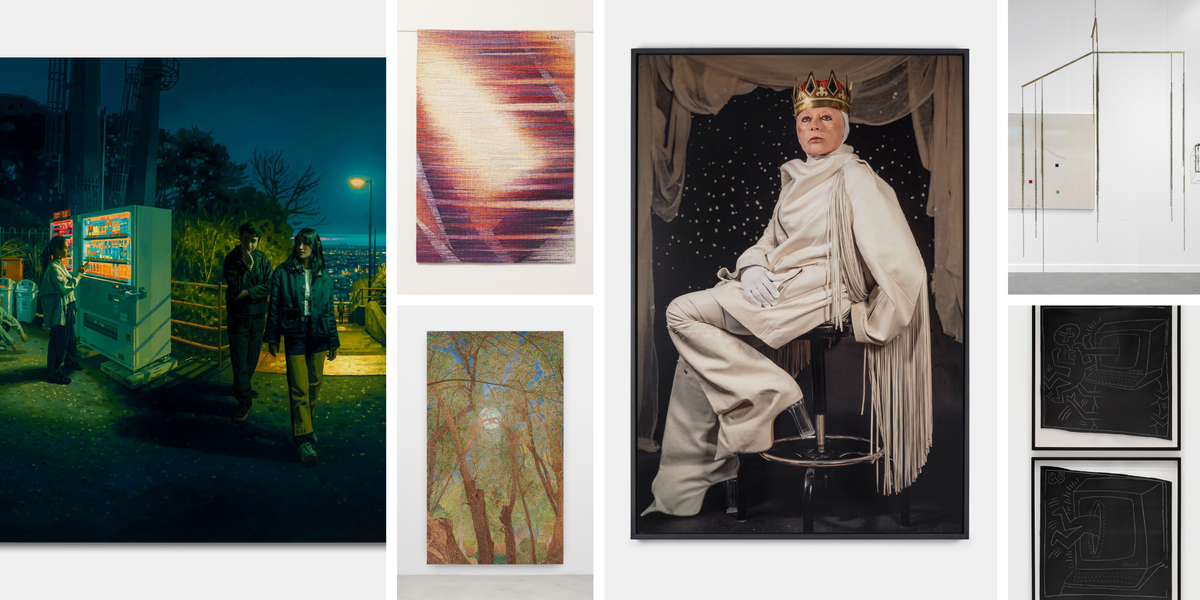
Andrew Kreps Gallery presented one of the fair’s most understated yet resonant booths, anchored by two “Untitled” Keith Haring subway drawings from 1985 rendered in white chalk on black paper. Originally created on unused advertising panels throughout the New York City subway system, Haring’s subway drawings have become some of the most iconic images associated with downtown New York in the 1980s, capturing the collision of street culture, nightlife, activism, performance, and contemporary art that defined the era.
Few artists remain as visually synonymous with New York itself as Haring, whose instantly recognizable graphic figures transformed public space into an accessible site of art-making. Emerging out of the East Village and downtown club scene alongside figures like Jean-Michel Basquiat, Madonna, and Kenny Scharf, Haring blurred the boundaries between fine art, fashion, music, and activism while building a visual language that continues to resonate across generations.

“Untitled (Subway Drawing)” by Keith Haring.
Installed with striking restraint inside the booth, the drawings retained an immediacy and rawness that cut through the polish of the fair itself. The chalk lines moved with the speed and rhythm of something made in transit, carrying the restless energy of the subway system where Haring first created them. Against the deep black paper, the bright white figures almost seemed to pulse beneath the fair lighting, their dancing forms and graphic outlines feeling playful, urgent, and unexpectedly tender all at once.
Hauser & Wirth, Booth B08
Hauser & Wirth drew steady crowds throughout opening day with new photographs by Cindy Sherman, whose influence on contemporary photography, fashion imagery, and feminist art history is nearly impossible to overstate. Across more than four decades, Sherman has fundamentally transformed the self-portrait into something psychologically charged, theatrical, unsettling, and endlessly shape-shifting. Her groundbreaking “Untitled Film Stills” series from the late 1970s helped redefine the possibilities of photography itself, influencing generations of artists, filmmakers, designers, and image makers in the decades that followed.
The newer works on view at Frieze continued that same investigation while pushing Sherman’s imagery into increasingly exaggerated and uncanny territory. Across the photographs, Sherman disappeared entirely into elaborate wigs, prosthetics, theatrical makeup, and carefully constructed personas that oscillated between glamour and grotesque artifice.

Hauser & Wirth, Booth B08, at Frieze New York 2026.
In one especially unforgettable image, Sherman appeared perched on a stool wearing a paper crown and heavy stage makeup that transformed her into something resembling a haunted society doll. Painted-over eyebrows, a pristine white ensemble, and her distant expression heightened the tension between absurdity, elegance, performance, and decay that has long defined her practice. Positioned prominently within the booth, the photographs quickly became one of the fair’s most photographed and talked-about presentations.
Tina Kim Gallery, Booth A9
Tina Kim Gallery presented one of the fair’s most elegant booths, bringing together more than 10 artists whose practices blurred the boundaries between sculpture, textile, painting, and installation.
Among the strongest works on view were pieces by South Korean artist Suki Seokyeong Kang, who tragically died of cancer last year at age 47. Kang built an interdisciplinary practice that moved fluidly across media, and the works featured at Frieze hovered somewhere between painting and sculpture, creating a palpable tension when encountered in person. Curved metal rods, suspended fabrics, and sculptural forms interacted across the booth, while subtle references to grids and Korean musical structures reflected the deeply research-driven nature of her work. Despite the formal rigor of the pieces, the installation retained a softness and emotional power that drew viewers in slowly.

“Mountain #25-07” by Suki Seokyeong Kang.

“Image of Light” by Lee ShinJa.
Another standout came from pioneering fiber artist Lee ShinJa, whose work helped redefine textile art in postwar South Korea, pushing a medium often dismissed as craft into a more rigorous space of fine art. Her monumental tapestry “Image of Light” from 1986 brought many of those ideas together into a single work. Measuring nearly eight feet tall, the richly textured composition blended painterly gestures with variations of orange, butter yellow, burnt sienna, violet, and deep purple that moved across the surface in layered streaks and organic forms. At 96 years old, ShinJa’s work still feels remarkably contemporary, and the presentation at Frieze underscored the broader return to textile-based practices seen across many of the fair’s best booths this year.
Almine Rech Gallery, Booth D04
Founded by Almine Rech, the wife of Pablo Picasso’s grandson Bernard Ruiz-Picasso, the Paris-based mega-gallery presented one of the fair’s most visually polished booths, bringing together 18 artists under a loose exploration of light, shadow, and perception. The booth moved fluidly between generations and aesthetics, pairing works by blue-chip names including Larry Poons and Jeff Koons with younger contemporary artists whose practices pushed figuration and realism in new directions.
One of the undeniable standouts came from Japanese painter Keita Morimoto, whose monumental painting transformed artificial light into something deeply cinematic. Known for his photorealistic depictions of illuminated urban nightlife, Morimoto captured shadowy storefronts, glowing streetlights, and passing figures with an almost filmic intensity.

“Distance from Light” by Keita Morimoto.
The nearly 11-foot canvas glowed from across the aisle, pulling viewers toward it throughout the afternoon with saturated electric blues and luminous flashes of light that cut through the darker surface of the painting. Amid the visual overload of the fair itself, the work felt unexpectedly intimate, balancing loneliness, glamour, and urban isolation all at once.
The Modern Institute, Booth A04
The Glasgow-based gallery The Modern Institute brought a quietly refined group presentation to Frieze this year, though one of the booth’s most striking moments came through an installation by Scottish artist Martin Boyce. Known for transforming architectural and industrial forms into powerful sculptural environments, Boyce presented works that felt at once ghostly and familiar.
At the center of the installation was Boyce’s ethereal mobile “By the Water” from 2013, a delicate arrangement of metal forms that appeared to float weightlessly through space. The work recalled willow tree branches swaying in the wind while also drawing on the geometry of modernist design. Despite the industrial materiality of the piece, the installation retained a remarkable softness and lightness, conjuring larger ideas surrounding fragility, time, memory, and the tension between the natural and constructed world.

The Modern Institute, Booth A04, at Frieze New York 2026.
Nearby, Boyce’s “The View” continued his long-running fascination with masks, concealment, and coded language through angular text derived from modernist sculptural forms originally created for the 1925 Paris decorative arts exposition. Together, the works introduced a quieter register into the fair, balancing melancholy and elegance with an almost dreamlike sense of suspension.
As the crowds continued moving through the Shed late into the evening, Frieze New York once again proved why it remains one of the defining events of the city’s cultural calendar. Beneath the choreography of relentless social circulation, many of the fair’s strongest presentations carried an unexpected emotional depth and sense of restraint. What emerged over the course of opening day felt less like a singular trend and more like a broader shift already taking shape across the contemporary art world, one grounded in material presence, emotional acuity, and the quiet power of sustained looking.
Frieze New York 2026 runs through May 18 at the Shed in Hudson Yards.
[ad_2]
Source link