[ad_1]
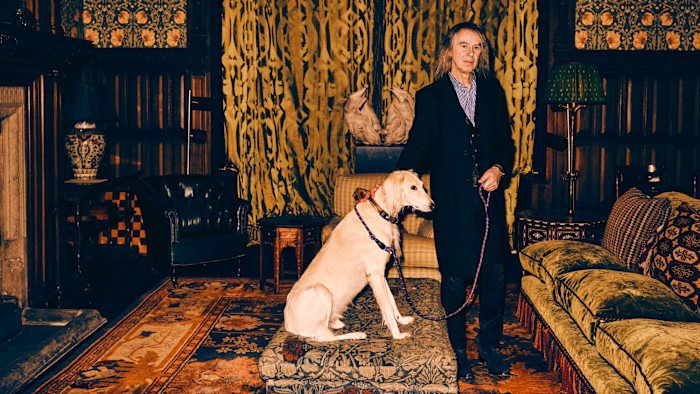
My personal style signifier is my long hair, which I’ve had since I was 10. That may seem conventional today, but in 1964 it was going against the grain. My father called me a pansy, which in those days was a designation of queer… which I wasn’t. But he thought I looked like one. I also love to wear black leather waistcoats. I have a collection of them, all bought from a wonderful shop off Rodeo Drive in Los Angeles called West. It sells cowboy boots, which I’m addicted to wearing. I have them in lizard and gator.
The place that means a lot to me is Manchester. I grew up in the beautiful countryside of Cheshire, between Alderley Edge and Macclesfield. I spent my childhood playing with my friend Graham Moss in the woods, and it always makes me think of what George Eliot referred to as the “sanctity of memory”. Perhaps we see those places through rose-tinted spectacles but we can never regain the intensity of feeling we had then. Playing in the woods in Alderley is what matters most to me; we went down old copper mines, potholing and inventing games. Now I live in Cadogan Square, London, in a five-storey northern-gothic house built by Harold Peto and Sir Ernest George in 1886.


The book I’m reading again is Armadale by Wilkie Collins. It was written in the 1860s; one character is a flame-haired temptress called Lydia Gwilt. She’s a femme fatale whose idea of fun is to annoy men. I’d pass that on for a racy read. A brilliant book I wouldn’t pass on, because it’s too harrowing, is Émile Zola’s La Débâcle, about the appalling misjudgement of Napoleon III in taking on [German chancellor Otto von] Bismarck in the Franco-Prussian war. The vivid descriptions of amputations, people dying in the mud, horses’ bloated corpses floating down the river and the endless charnel-house atmosphere bring home the horror of war and underline its blasphemous nature. It’s utterly contemporary.
I have a collection of 19th-century furniture – Edward William Godwin pieces, William Morris fabrics and rugs, Christopher Dresser metalwork and ceramics, and William de Morgan tiles and plates – all 1860 to 1900. I also have an art inventory connected to my dealing business; I started collecting in 1978. In retrospect it feels like I had a crystal ball. I was buying Bridget Riley, Francis Bacon and Stanley Spencer then. As a dealer, you need to have a perception of what’s going to have cultural resonance way ahead of time.

My style icons are King Charles, Bryan Ferry and Robin Birley. The King manages to have an endless variety of clothes for every occasion, and none of them are boring. He rings the changes while keeping a very individual style. Bryan Ferry, I don’t think I need to elaborate. He epitomises cool. And Robin Birley’s style is not merely sartorial, it is behavioural. As Iago says of Cassio in Othello: “He has an inner beauty in his life.” I appreciate the level of Robin’s good manners and courtesy.
Being an only child has made me depend on friendships. I value human relationships that I choose rather than having them imposed upon me.
Family for me is my parents, as I don’t have brothers or sisters. I have cousins but it’s not the same thing. My grandmother was born in Damascus and came to Manchester on a boat via Marseille in 1919. When she arrived, she signed with a thumbprint as she couldn’t write. Aged 13, she married Isaac Braka and had her first son, David, at 14. It’s my girlfriend Liz and my friends who are my family. I’ve been married three times and am close to both my sons, Joseph [29] and Jack [20], but I only lived sporadically with them in a family unit. Last, but not least, Sami, the Saluki dog, is also family.
Parenting is an awesome responsibility. It’s innate rather than volitional. I’m not gushy; I prefer to keep things closest to me private. But my sons know exactly where they stand with me. They are their own people. I don’t try to live my life through them in any way. I’m not a helicopter parent.


In my fridge you’ll always find white burgundy, chablis and Chassagne-Montrachet, a magnum of vintage Krug, Pol Roger white label, skimmed milk for me, semi-skimmed and full-fat milk for guests, Diet Coke, San Pellegrino, and Hellmann’s mayonnaise. Plenty of alcohol and no food. I actually like cooking – things like pastas and roasts of various kinds – but I buy the food on the day I need it, otherwise I’d eat it all. And I’d like not to do that.
The last thing I bought and loved was The Songs and Sonnets of John Donne, which I find inspirational – I love the combination of emotion and acute thinking. Poetry is missing in life today, so it’s an important thing to focus on.

The artwork that has been in my family the longest is Northleach Church, an LS Lowry painting of a graveyard in the Cotswolds. We’ve had it since my father was a partner of Andras Kalman, founder of the Crane Kalman Gallery, in the 1950s. My father financed the gallery. As an only child, I was the recipient of his largesse. He made his money as a textile converter in Manchester, aka “Cottonopolis”, profit centre for the British Empire. In Manchester terms, he was a very successful businessman. We disagreed about practically everything but we were close. He was a manic-depressive but also very amusing.
The best gift I’ve given recently is a Hockney iPad drawing of spring to my son Joseph. I told him to sell it, as it’s gone up from $20,000 to $350,000. The best gift I’ve ever given was my Apreamare, a nine-metre retro fishing boat, to Jerry Hall who, like me, has a house in the south of France. That may seem like an over-generous gesture but it wasn’t; it was costing me a fortune every year in upkeep and I had just bought a new boat. I figured Jerry could handle the liability better than me.


And the best gift I’ve received is my mother’s happy nature. She enjoyed sunshine, rain, nature and animals, and had a positive attitude to life. Her name was Betty – Elizabeth Braka. I was very close to her. Also, despite being an atheist, she faced her death – at age 87 from a brain tumour – with complete equanimity.
The best way to spend £20 is at my pub, The Gunton Arms in Norfolk. Get the curry and chips and a couple of pints of local ale. The executive chef, Stuart Tattersall, uses the same curry recipe as the one served outside Old Trafford, Manchester United’s football stadium. I also own the Suffield Arms opposite Gunton station. I bought them because they were in need of rescue and are near my country house in Norfolk, where I’ve just finished restoring Gunton Park, planting more than 500,000 trees. Rebuilding the community around Gunton has been a hugely important part of my life.

My favourite room in my house is my bedroom; that’s where the Sickerts hang.
Owning pubs has reinforced my strong conviction that a pub – unlike a restaurant – is a place where you can interact with people from all walks of life. You can have a duchess meet a cowherd or a postman, and you can strike up random conversations from which you can then slide gracefully away. A pub provides a vital stage for social intercourse, which has been lost in an age of increasingly virtual contacts. Social media is anathema to me. In a pub you can stave off social isolation and loneliness, particularly in rural areas.
An indulgence I would never forgo is my weekly Sunday-night dinner with my fellow art dealer and friend John Erle-Drax. We talk about family, what we’ve done at the weekend and about business. We’ve made a lot of deals over our dinners. I’ll scribble down – on paper tablecloths if they have them – ideas John gives me about approaching clients. We go to Giovanni in Yeoman’s Row, Olivo on Eccleston Street, and Cambio de Tercio, owned by my Spanish friend Abel Lusa.


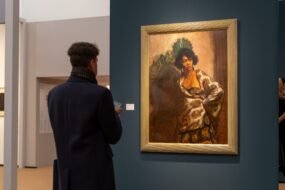
I would never part with my collection of four Walter Sickert paintings depicting poverty-stricken women. He had a real understanding of the human condition. I’m not saying they are technically as good as his hero Degas, but Degas’ pictures of ballerinas and sex workers washing don’t have Sickert’s immediacy or pathos. He advocated for art that “sticks to the kitchen” rather than the refinement of the drawing room. It’s the opposite of Sargent.
The grooming staple I’m never without is John Frieda’s Frizz Ease Serum. I don’t like curly hair. I take care of my hair myself as it’s fragile; I give it an occasional cut with my kitchen scissors. I also have a personal trainer, Roland Feizo. He comes to the house or I train with him in the park. I also go to Stars Gym in Battersea twice a week, where a lot of boxers and bouncers go. John Frieda Frizz Ease All-in-1 Lightweight Serum, £7.99, sephora.co.uk

The works of art that changed everything for me were part of the Edvard Munch exhibition at the Hayward Gallery in 1973. It made me aware that art could render inner states of mind as well as landscapes or other things. Munch has a wonderful awareness of man’s place and dislocation from the natural world and the universe. A dislocation even from himself. I’m not just thinking about The Scream, but also Two Human Beings (The Lonely Ones), standing side by side on a shoreline.
Some of my best ideas have come from drinking a gin and tonic while listening to “Nights in White Satin” by The Moody Blues. I discovered this combination as a young art dealer. When I had a client coming, I’d play it three or four times to reach a positive frame of mind. I felt I could sell almost anything if I’d done that.


I love rock music and the proto-punk element of Iggy Pop and The Stooges. I wear Alice Cooper black eye make-up for parties quite frequently. I do it myself – it’s black kohl and takes me five minutes.
I’ve recently rediscovered gin Martinis with a lemon twist. I usually start the evening with a glass of white wine, but a friend of mine always has a gin Martini when we meet, and I thought, “What am I missing?”

In another life I would have been an English teacher. It would necessitate my reading great literature and poetry on a daily basis. And, in the course of teaching, I would deepen my understanding of it. The axing of arts subjects from the national curriculum is sad. Britain leads in so many creative areas that contribute [to society] in ways that are hard to assess on a balance sheet. But they are an essential part of our economic and spiritual life.
The last music I downloaded was Seraphim Bit-Kharibi’s Chanting in the Language of Christ; it’s sung in Aramaic, the language that Jesus spoke, a bit like Gregorian chant. I also downloaded Wet Leg, who Bryan Ferry recommended.
My favourite game is tennis, but it was squash until my cardiologist told me to give it up. Tennis is incredibly exacting; you have to be very good at it to have a consistent game. Squash is like 3D chess: the variety of shots, playing a slow game or flat out, the different angles, the strategy and the sheer exuberance of draining the last drop of energy out of you. It leaves you feeling keyed in for the rest of the day.
Do I believe in life after death? That is a binary question. Like my mother, I would define myself as atheist, but that doesn’t mean I don’t have a sense of spirituality. I certainly believe in nature and a life force, but I don’t believe in a God that’s going to reward or punish.
The best bit of advice I ever received is by Walter Pater, Oscar Wilde’s tutor at Oxford. In his conclusion to The Renaissance, he wrote that “to burn always with this hard, gem-like flame, to maintain this ecstasy, is success in life”. That is my motto: to live in the present, to live every moment.
[ad_2]
Source link