[ad_1]
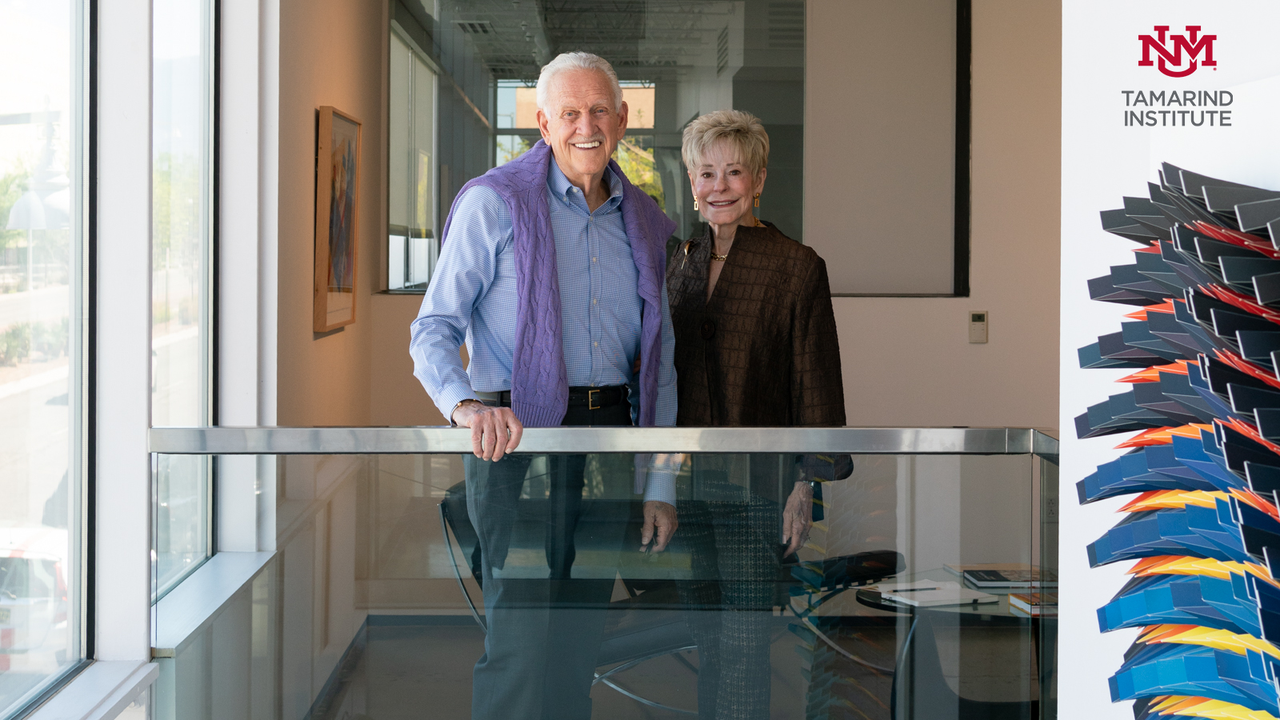
Sandra Odell and Douglas Ferraro, both University of New Mexico Ph.D. scholars, have long been supporters and collectors of The Tamarind Institute since the 1980s. They have recently established the Sandra and Douglas Ferraro Artist Residency at Tamarind Institute. Their gift reflects their long-time passion for Indigenous art, lithography and an investment in the future.

Sandra and Douglas Ferraro visit the Tamarind gallery to see the Jaune Quick-to-See Smith exhibition
“Our hope for our supported Indigenous artists’ residencies is to ensure that these partnerships continue and that young, upcoming Indigenous artists will have the opportunity to develop their artwork in the workshop with outstanding printers,” said Ferraro and Odell.
Beginning in 1978, Ferraro and Odell acquired their first pieces from Native American artists, setting them on a path to focus their personal art collection on Indigenous artists. These first pieces included an earth painting by Pablita Velarde, a 1979 acrylic by Helen Hardin, a 1980 pastel by Jaune Quick-to-See, and their first Tamarind lithograph by Fritz Scholder, his 1980 “Snake Dancer,” printed by master printer Stephen Britko.
These acquisitions sparked what they call “a continuous feedback loop of learning and a desire to acquire more contemporary Indigenous art.”
Known internationally as a leader in fine art lithography, Tamarind has a long history of connecting artists and printers to expand the boundaries of modern printmaking. A practice that the Ferraro’s have supported through their own collection, advocacy, and, now, their residency program.
“With the support of this generous funding, over the next several years, Tamarind will be able to expand our focus on Indigenous artists from across North America,” said Diana Gaston, the director of The Tamarind Institute. “These residencies will build on a long tradition of Tamarind partnerships with Indigenous artists.”
Odell and Ferraro cemented their connection while they were working and researching at The University of New Mexico in the 1960s. Ferraro arrived at UNM from New York as a newly minted assistant professor of psychology in 1965 and retired 25 years later, achieving the rank of chair for the Department of Psychology.
Odell arrived at UNM from Las Vegas as a junior undergraduate in 1969. She ultimately earned her B.S., M.A., and Ph.D. in education curriculum and instruction by 1978, and achieved the rank of associate professor in the College of Education.
Lucky for the Ferraros, Tamarind relocated to UNM in 1970 to become a part of the artistic and cultural environment. They first visited Tamarind in 1980, where they were introduced to the art of lithography and met with then Publications Manager Marjorie Devon. An occasion they described as “that engendered our subsequent love of works on paper.”
Both were fueled by an old adage that one can best come to know a culture through the eyes of its artists, which was spurred by Odell’s Ph.D. dissertation project that highlighted new methods of teacher education within the Navajo Nation.
“By the mid-1970s, we were avidly collecting together original paintings, sculptures, and pottery by New Mexico artists,” they said.
In 1981, they joined the Tamarind Collectors Club as inaugural members. They continued to be impressed with each acclaimed artist Tamarind chose for the collector’s club, solidifying their lifelong membership.
Their personal collection spans decades, showing how prints have evolved over time. It features works by influential artists who inspired modern Native artists, including a family with three generations of artists, and features an overarching theme of female artists who depict the tensions that characterized Indigenous women as artists and printmakers.
The Ferraros shared that they have been drawn to works on paper for more than four decades for three reasons. First, the industry’s practice of bringing artists and printers together for unique artistic collaborations. Second, the art form’s heterogeneity, which supports various outcomes and ensures the creativity of both the artist and the printer, is clear; third, the community. They love knowing that the prints they enjoy can also be enjoyed by others, because of the nature of a lithography print run, which produces multiple impressions.
For a couple whose art-collecting journey was transformed by a single visit to Tamarind more than 40 years ago, their generous gift honors a place that fueled their passion and shaped their understanding of art, while supporting artists and collaborators who continue to push the boundaries that sustain Tamarind’s work and mission.
The Sandra and Douglas Ferraro Artist Residency at Tamarind Institute will continue to support and fuel the local artist scene and help foster long-lasting partnerships for years to come.
To learn more about Tamarind Institute’s work and gallery, visit their website. To support their ongoing community collaborations, visit their support page.
[ad_2]
Source link