[ad_1]
The UK’s creative industries are facing a quiet but profound contradiction.
While employers are calling for more creative, technical and collaborative skills, opportunities for young people to develop them are shrinking. The steady decline of arts subjects in schools – particularly Art and Design Technology – has been widely documented. But what is less often discussed is what is lost alongside: access to making, to materials, to experimentation and to creative thinking.
This is not simply an education issue. It is a pipeline issue for the entire sector.
If young people are not given meaningful opportunities to think through making – to test, build, fail and try again – we narrow the future creative workforce before it has even begun.
From education to industry
For many years, the dominant narrative around creative careers has followed a familiar path: school, university and then into the sector. But this route is becoming increasingly fragile.
University places in the arts are increasingly for the affluent. At the same time, academic career pathways are limited, leaving fewer viable routes for artists to sustain their practice through higher education. Alongside, schools are under pressure, with fewer specialist teachers in art and design, and less capacity to offer practical, material-based learning.
This leaves a gap – for young people and for artists.
Mid-career artists in particular are navigating an increasingly precarious landscape, seeking ways to sustain their practice, diversify their income and expand their impact. Yet there is very little structured support for artists to work meaningfully in schools and communities, despite clear demand.
What if we saw this not as a problem, but as an opportunity?
Artists in schools
Working in schools is often framed as outreach or education work, something adjacent to an artist’s ‘real’ practice. But this framing undervalues what is possible. Properly supported, artists working in schools are not simplifying their practice; they are expanding it.
They are translating complex ideas into accessible forms. They are working with new materials, contexts and constraints. They are engaging with real questions rooted in place, community and environment. And crucially, they are shaping how the next generation understands creativity itself.
This requires a shift in how we support artists.
It is not enough to assume artists can step into classrooms without preparation. Teaching is a specialist skill. Schools are complex environments. If we want artists to succeed in these spaces – and to see them as viable, respected areas of practice – we need to invest in training, development and peer exchange.
Sculpture as a bridge
At the centre of my argument is sculpture, but perhaps not as it is traditionally understood. Sculpture, in its expanded form, is uniquely positioned to bridge education, industry and community. It is inherently interdisciplinary. It brings together art, design, engineering, materials science, digital technologies and spatial thinking.
It asks different questions: How does something stand? How do materials behave?
How do ideas move from concept to production? How does a work relate to the people and place around it?
These are not only artistic questions. They are questions that resonate across sectors from manufacturing and construction to environmental design and emerging technologies. When young people engage with sculpture as a process, and not just an outcome, they begin to understand how ideas are developed, tested and realised in the real world.
Learning revolution
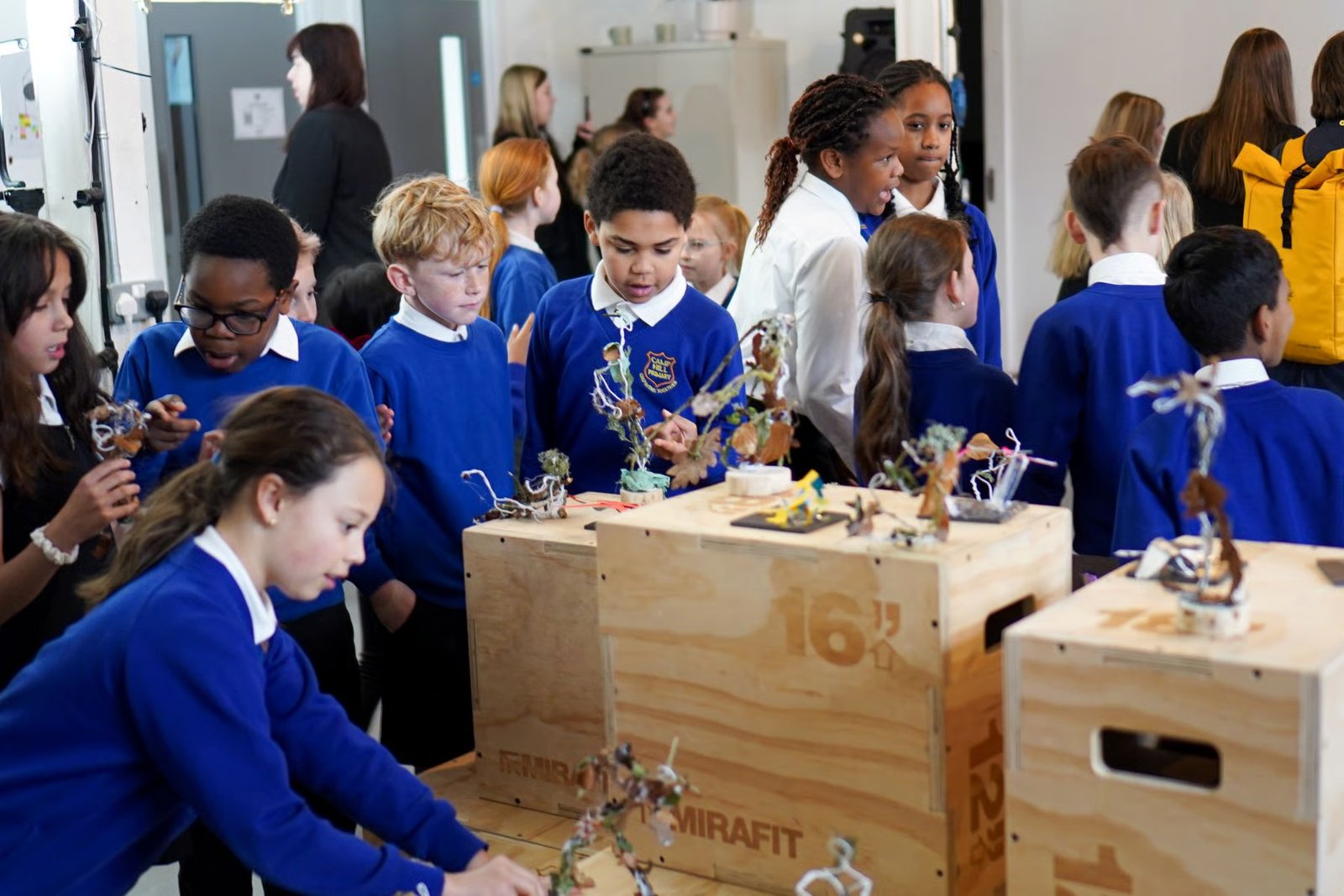
This has been borne out by a recent R&D programme led by Pangaea Sculptors’ Centre*. Working in partnership with The Futures Trust and six schools in Coventry and North Warwickshire, the programme tested a new model of sculpture-led learning through sustained artist residencies.
The project positioned sculpture as a framework for wider learning. Pupils worked with practising artists on a real, place-based question, developing proposals for site-specific public artworks connected to their school or local area. Through this, they moved through a structured design process: researching context, testing materials, developing and refining ideas, and presenting outcomes.
Material practice remained central, with pupils handling tools, constructing forms and learning through iteration. Digital technologies such as 3D scanning and modelling were integrated alongside this; not as add-ons, but as part of a wider making toolkit. Crucially, the programme connected pupils to real-world contexts: working with industry partners, visiting fabrication environments, and understanding how ideas move from concept to production.
What emerged was not only strong creative outcomes, but a deeper form of learning, one that connected material thinking, digital fluency and civic awareness, and demonstrated how sculpture can operate as a bridge between education, industry and place.
Articulating value across sectors
One of the arts’ ongoing challenge is how to articulate our value beyond the sector. When sculpture is understood through the lenses of education, skills, industry and place-making, its relevance becomes clearer to a much wider audience.
Industry partners recognise the value of working in this way and schools are seeing how making supports not only creativity, but communication, collaboration and problem-solving.
Sculpture also offers a way to connect learning to wider questions of civic agency, sustainability and the built environment, helping young people understand how ideas are shaped, realised and situated in the world around them.
This is not about instrumentalising art. It is about revealing its full potential.
Building a more resilient future
If we are serious about the future of the creative sector, we need to think differently about how we build it.
This means:
• Creating meaningful access to making for all young people, not as an optional extra, but as a core part of learning
• Supporting artists to develop sustainable, expanded practices that include work in schools and communities
• Recognising and investing in interdisciplinary approaches that connect art, industry and education
• Articulating the value of creative practice in ways that resonate beyond the sector.
The challenge is significant. But so is the opportunity. By rethinking the relationship between education, artists and industry, and by recognising the unique role sculpture can play in this, we can begin to rebuild a creative pipeline that is not only more resilient, but more inclusive, dynamic and relevant to the world we are now in.
*Pangaea leads the DCMS / Innovate UK-supported 3D–5D Learning Revolution, prototyping a national approach to interdisciplinary, practice-based education. The programme has been developed in partnership with The Futures Trust, with support from the Alan Higgs Charitable Trust and industry partner Penta Patterns.
[ad_2]
Source link