[ad_1]
9-Ball Is a Family Affair by Kathi Scrizzi Driscoll | The Future Ocean Bohemians by Pat Kearns | Natalie Stopka Botanical Colors by Juliet Leary | The Hills Are Alive by Susan Rand Brown
9-Ball Is a Family Affair
Macklin Devine wasn’t born yet when his father Art Devine’s Vietnam War-era play 9-Ball debuted at Cape Rep Theatre in 2001. But Macklin remembers photos, phrases, and discussions about the show being part of his family’s “household lore.” At 10, he helped at rehearsals but was kept clear of the play’s coarse language.

Now 22, Macklin is starring in the 25th anniversary production of 9-Ball kicking off Cape Rep’s season. He plays Richie, a troubled youth who swaps lives over a pool game with meek Larry (Elijah Corbin). Richie ships off to Vietnam, while Larry is imprisoned for Richie’s crimes. The plot and characters are based on real events, inspired by Art Devine’s 1969-1970 stint as a Green Beret.
Both son and father call this restaging a “full-circle moment,” especially one scene where Richie is in jump school. The significance is not lost on Macklin or Art; the production features Macklin recreating a scene in a photo from his father’s collection.
“It’s a privilege to get to use his words and his story,” Macklin says. “Paying homage to my father is a huge part of not only why I wanted to do the show but why he cast me as Richie.” While the two have collaborated on previous theater projects, this is their first actor-director experience.

This is not the family’s first homage to Art Devine. Macklin’s two older brothers formed a hard-rock band that Macklin joined a year later. The group’s name, Club 9-Ball, refers to the nickname actors gave the bar section on the set of the original play. In addition to recording, the band founded the Veterans Rock Music Festival to benefit local veterans.
Fans of the group, or the trio’s 2023 Archibald Avery horror musical, know the Devine brothers sport long locks and facial hair. As Vietnam recruit Richie, Macklin Devine is now clean-shaven with a buzz cut. “This is the first time I’ve seen my top lip in eight years,” he says.
9-Ball runs May 6 to 31 at Cape Rep, 3299 Rt. 6A, Brewster. Tickets are $30 and $40, with student rush and a pay-what-you-like performance on May 8. See caperep.org. —Kathi Scrizzi Driscoll
The Future Ocean Bohemians
“The performance crosses centuries, and all writings have to do with how we experience the ocean, how it came to be, and what its future will be,” says artist and ecologist Mark Adams of the latest installment of “Ecosystems & Imagination | Future Ocean Bohemians” at Twenty Summers. Adams considers the performance “a pastiche of acts,” anchored by a 40-page play he assembled from “a literature of the coast — science to theater and poetry.”

Kat Wright paints a picture of the performance, a psychedelic web of stream-of-consciousness ocean text, movement, and song about “why the sea calls for us.” Adams uses projections for visuals, with the play taking place on top of a giant map of the world’s oceans he’s been working on for the last month. The play is eclectic — it includes sections from Shakespeare’s The Tempest, shellfishermen conversing with a British yachtswoman, Jeanne Socrates, and a giant cuttlefish.
Katie Castagno and Tommy Tucker of the Center for Coastal Studies demonstrate their versatility in a variety of roles, appearing as shellfishermen, captains, and cuttlefish. The actors will be joined in the performance by baritone Colin Levin. Artist Joe Hay will play the drums, and Josiah Mayo will play guitar and read passages from Melville, Thoreau, and Benjamin Franklin. Cellist Parker Ousley brings his intricate pizzicato, strumming patterns, and fiddle-like bow technique to the work.

Wright’s voice shines in a musical vignette featuring a Connie Converse song. But she will also sing one of her own numbers, “I Go Down to the Water.” Wright says the song is “a piece of mine about Lake Champlain where it’s restful and meditative. There are sections about wanting to disappear and become formless like water. It’s about being overwhelmed and finding solace in water.”
The performance will be at the Hawthorne Barn (25 Miller Hill Road, Provincetown) on Thursday, May 14 at 6 p.m. RSVP required; suggested donation, $20. See 20summers.org. —Pat Kearns
Natalie Stopka Botanical Colors
Natalie Stopka first thought making plant pigments would require a centrifuge, a vacuum filter, and “an advanced degree in chemistry.” Then she started reading late medieval pigment recipes. “If medieval craftspeople could make these, so could I,” she says.

Stopka, an artist, educator, gardener, and author of From Plant to Pigment, will give a talk and pigment-making demonstration at the Dennis Conservation Land Trust (107 Sesuit Neck Road, East Dennis) at 2 p.m. on Wednesday, May 13.
The book, published in 2025 by Skittledog, teaches artists how to transform botanical dyes into lake pigments, paints, inks, and pastels.
“Plant dyes and pigments give me the excuse to get out into nature and give nature a voice in my artwork,” says Stopka. Their colors “materially connect my artwork to local ecology.”
In Dennis, Stopka will demonstrate how invasive buckthorn can be made into a usable pigment. She will also open her traveling archive of botanical color, which includes some of the over 200 colors she created while testing recipes, along with paints and pastels made from them. Some experiments were “vibrant successes,” while others were “less-than-stellar shades,” she says.

Lake pigments, Stopka says, are made by attaching a natural dye to an insoluble mineral carrier, often aluminum hydroxide, which binds the dye and turns it into a usable pigment. The process allows plant color to move into paint, ink, pastel, and other durable materials. She describes lake pigments as “ingenious pre-industrial manmade hues uniting the qualities of organic and mineral colorants.”
In researching the book, Stopka found that fermentation played a larger role in historical dyeing than she had expected. “I was surprised by how much more color is unlocked from certain plants by allowing microbes to help digest them,” she says. “Fermentation is amazing!”

Because the talk is being presented by the conservation organization, the event will place special emphasis on water quality, ecological stewardship, and ethical foraging. Common buckthorn and yellow flag iris, both familiar on the Cape, can produce prolific color while also raising questions about invasive species and the wetlands they affect.
“Artists’ materials don’t merely stock the shelves of the art supply store,” says Stopka. “They are growing all around us.” The event is free. See dennisconservationlandtrust.org. —Juliet Leary
The Hills Are Alive
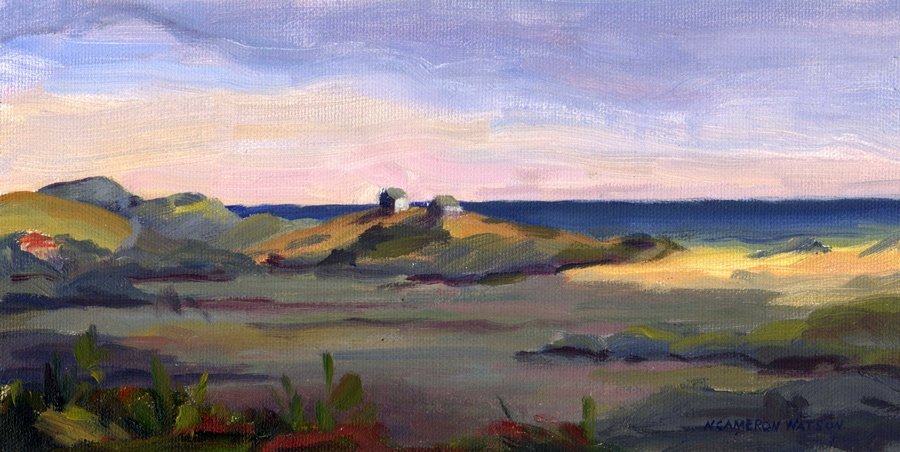
Plein air painting on the Outer Cape has a rich history. The practice dates back to at least 1899 with Charles W. Hawthorne, founder of the Cape Cod School of Art, who was followed by his protégé Henry Hensche. To this day, artists are influenced by the Outer Cape’s light.

Beginning May 13, Truro Center for the Arts at Castle Hill (10 Meetinghouse Road) will offer a series of workshops in plein air painting. “Plein air painting is an important part of our programming,” says Executive Director Cherie Mittenthal. “This tradition invites artists to engage directly with the landscape — and there are few more beautiful places to paint.”
Workshop participants can expect to learn from a range of artists. The first session, “Why Do We Paint Directly From Nature?” offered by Mary Giammarino, runs Wednesday, May 13 to Friday, May 15 and again Monday, July 6 to Friday, July 10. A contemporary Impressionist painter focused on capturing light and color, Giammarino creates paintings of the Outer Cape using a palette knife that often tilt toward abstraction. In the course description, Giammarino says, “Painting from nature is a specialized skill everyone can develop.”
In “Landscape Painting With Ink and Watercolor,” Tuesday, June 16 to Thursday, June 18 (led by the Independent’s Arts Editor Abraham Storer), painters will work from watercolor notebooks to create sketches and small paintings of the Outer Cape landscape, focusing on expressing the subjects being observed. Storer uses landscape painting in particular to explore place as well as a way to look inward.

Cammie Watson’s workshop, “Plein Air Landscape Painting,” Monday, June 22 to Friday, June 26, brings students into the studio and outdoors to hone their skills. Participants can use whatever medium they are comfortable with.
Movement is a key theme of the courses. “Cape Landscape Painting,” taught by Donald Beal from Monday, July 13 to Friday, July 17, meets at a different Outer Cape location for each session. Participants will work on one painting per session as well as multiple quick oil studies. John Clayton’s workshop, “Painting Truro in Plein Air and in the Studio,” Monday, July 20 to Friday, July 24, involves working in and around Truro. Students will create small studies to determine which will make a larger studio painting.

Hawthorne believed that seeing the outdoors is what made art beautiful. Over a hundred years later, his teachings are still alive on the Outer Cape. To register, see castlehill.org. —Susan Rand Brown
[ad_2]
Source link