[ad_1]

Phillips may not have made as much noise ahead of this season’s marquee sales as the other major houses, with their announcement of major estates and consignments, but its specialists have certainly been busy. Its May 19 white-glove Modern & Contemporary Art Evening Sale generated a total of $115,216,700 across 41 lots, achieving 100 percent sell-through by value and more than doubling last year’s result. Less than half of the lots were secured by guarantees, suggesting that Phillips’ new Priority Bidding incentive, introduced in July 2025, contributed significantly to the result. According to data reported in January, 40 percent of all sold lots have attracted such bids since the program’s launch, and in the evening sale, more than half of the lots received priority bids, with bidders receiving a 4 percent discount off the buyer’s premium in exchange.
The sale kicked off “with a bang,” according to Phillips’s chairman and worldwide head of modern and contemporary art, Robert Manley, with the three opening lots surpassing their estimates. Salman Toor’s Two friends sold for $333,400 against an estimate of $180,000-$250,000, a Cecily Brown from 2019 soared to $670,800 against an estimate of $300,000-$500,000, while an unusual and rare pastel on canvas by Lee Bontecou dated 1985 fetched $4.2 million, more than tripling its $1.2-1.8 million estimate and setting a new record for a two-dimensional work by the artist.
The sale proceeded with solid results within estimates across both Modern and Contemporary works, with Monet’s La Route de Vétheuil, effet de neige (one of the evening’s top lots) achieving $9.3 million, followed by a 1960 abstraction by Pat Passlof that set a new auction record for the artist at $580,500, a Joan Mitchell sold for $6.9 million and Paul Signac’s Les Diablerets (L’Oldenhorn et le Bécabesson), which reached $2.3 million.
From there, Phillips tapped into niche regional markets with a work from the collection of Ambassador John L. Loeb Jr., one of the most significant assemblies of Danish art in private hands, with the first lots already successfully sold in March in London. Secured by guarantee and irrevocable bid, P.S. Krøyer’s Self-Portrait, Sitting by His Easel at Skagen Beach (Selvportræt, siddende ved staffeliet på Skagens strand) sold for well above its modest $300,000-$500,000 estimate, achieving $1.3 million with fees and setting a new auction record for the Danish modernist. Another work from the collection by Vilhelm Hammershøi landed within estimate to sell for $3.5 million with fees. Both works were reportedly acquired by prominent institutions, with the first closing on the phone with Tokyo-based strategy advisor Takako Nagasawa, suggesting it likely went to Asia. The following lot, a classic Morandi Natura Morta dated 1947, surpassed its high estimate, selling for $2.3 million with fees. Two more works by Vilhelm Hammershøi from the collection came later in the auction, landing this time under estimate at $490,200 and $2.9 million, respectively.
Other top lots of the evening followed, though generally landing within estimates. An Agnes Martin from 1985 sold for $4 million against an estimate of $3.5-4.5 million, while Andy Warhol’s iconic Sixteen Jackies from 1964, starting from an $11 million opening bid, achieved $16.2 million, against an estimate of $12-15 million. The work was making its fifth appearance at auction in five decades, having last sold at Christie’s in 2023 for $25.9 million. Another Warhol, Self-Portrait (1966), landed closer to the high estimate, selling for $4.8 million, while his deep-contrast blue and emerald 4 Colored Marilyns (Reversal Series) (1979-1986) sold for $5.6 million. In between, a luminous, thickly impastoed self-portrait from 1963 by Wayne Thiebaud—one of only a small number of self-portraits the artist produced, with others now in institutional collections such as the Smithsonian’s National Portrait Gallery and the National Academy of Design—achieved $1,999,500 against an estimate of $1.5-2.5 million, while Glenn Ligon’s iconic neon Double America 2 surpassed its high estimate, selling with fees for $2.7 million. Meanwhile, Gerhard Richter’s abstract work Besen, dated 1984, fell short of its high estimate even with fees, selling for $8 million.
Yet where Phillips continues to perform best is in the market for ultra-contemporary art, as proved by the Salman Toor result early in the auction. Following the new record set at Sotheby’s New Now evening sale last week, Joseph Yaeger’s 2021 painting There is a light and it always goes out triggered a heated bidding war across seven Phillips specialists on the phone and at least 10 bidders, pushing it to $477,300 from its $60,000-80,000 estimate and setting a new high for the in-demand painter. Anna Weyant, offered here with an early 2019 work a few lots later, again found the kind of near-million-dollar result she has been pursuing, chased by six bidders including Bernard LaGrange of Gagosian Art Advisory, landing at $980,400 against a more modest estimate of $380,000-450,000.
Phillips also continues to play a key role in the rise of Olga de Amaral’s market, having set the artist’s record last May when Imagen perdida 27 sold for $1.2 million, more than three and a half times its low estimate, pushing her market past the $1 million threshold—a result soon eclipsed at Christie’s last November, when Pueblo H sold for $3.1 million, setting a new auction record for the Colombian artist. This season, all three auction houses have at least one of her most coveted gold tapestries, and the one at Phillips activated fierce competition between phones, hammering at $1.3 million, or $1.7 million with fees, almost tripling its estimate of $600,000.
Veteran art advisor Dane Jensen, who has been actively involved with the artist’s market since early in its trajectory, noted how dramatically perceptions have shifted in just a few years. “It is amazing how a practice that, only five years ago or so, largely sat outside the mainstream art market has now firmly established itself as a true blue-chip force in the $1 million to $2 million-plus range,” he told Observer after the sale. “This represents a real market victory on many levels: for innovative practices that don’t fit neatly into established art historical narratives, for important mid-century women artists, and for Latin American art overall.” Jensen (who is launching a new company, La Finca Collection Strategies, focused on the sale of entire collections) added that a more telling result for the artist may be yet to come, with an exceptional example of her work set to sell at Bonhams on May 20.
Results for once-overlooked women artists of the 20th Century were notably strong: after Joan Mitchell’s Plain (1989) landed within estimate for $6.9 million, both Georgia O’Keeffe and Helen Frankenthaler surpassed expectations, with the former selling for $1.7 million against an estimate of $700,000-1,000,000 and the Frankenthaler fetching $2.2 million from its far more modest $600,000-800,000 estimate, clearly helped by the Gagosian effect, with the artist’s current show in Chelsea further fueling her market.
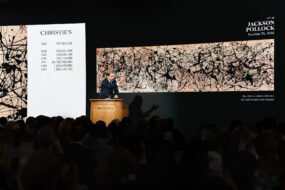
Phillips also reoffered a white-on-black Jackson Pollock drip painting from 1948, after its November 2024 sale collapsed into litigation following film producer David Mimran’s failure to pay the $15.3 million closing price. Consigned by the late Robert Mnuchin, Phillips put it on the block, in a move that may have benefited from the buzz around Sotheby’s sale of his collection and Christie’s offering of S.I. Newhouse’s major Pollock drip painting from the same year. Yet the prior legal complications appeared to affect demand, and the work sold for just $9.2 million to a client bidding by phone.
Overall, Phillips’ results are a testament to the advantages and safety of a pre-planned script, with specialists working hard before the sale to avoid surprises and secure enough bidding to keep the show going. “Amid the reverence for these incredible artworks, it has been wonderful to see our clients embrace Priority Bidding, Phillips’ industry-first initiative, which creates incentives for early engagement. A testament to its power, this Evening Sale saw a nearly six-fold increase in early selling bids year-over-year,” Manley said in a statement at the end of the sale.
According to art advisor Angelica Semmelbauer, the Phillips sale was stable in particular segments and artists but also more selective and cautious, especially when it came to ultra-contemporary artists. “I’m seeing a correction, especially in the ultra-contemporary female artists segment of the art market,” she told Observer. “The big takeaway for me is that there’s more knowledge-driven buying with a deeper understanding of the artists’ overall practice and career in terms of institutional support—and less of the more frenzied acquisitions of trend-driven names from years past.”
More in Auctions
[ad_2]
Source link