WeWork (oralmoral)
The Gallery
April 10–May 18, 2026
Brooklyn
Stepping into The Gallery, on the fourth floor of an office building in Crown Heights, one expects to find a crammed-in, highly calibrated art presentation feeding on idealized nostalgia for the non–art-market-driven New York spirit of the 1970s. What one finds instead is an unprescribed sense of openness anchored in the shared feelings of instability that emerge from the post-analog cultural moment. The Gallery is a temporal project undertaken by Berlin-born and New York-based artist-turned-curator Florian Meisenberg, who negotiated a rent-free arrangement for 4,000 square feet with a local landlord. So far, The Gallery has created a free-spirited space where multiple artists are welcome to generate their own micro-ecosystems, at liberty to show what has not been previously presented or envisioned. Although the works are for sale, Meisenberg relies more on an extensive community of artists around him for installation, programming, and word-of-mouth.
Upon entering the space, we are greeted by a gigantic black satellite dish, amplifying Anna K.E.’s sound piece, Tamada (2026), in which the artist works with the instability of communication, space, and the human voice to create a nonlinear toast to being human. On the other side of the narrow kitchen, The Whale to Live (2025)—a large, optimistic whale painted by Michael Egan—acts as a signifier of a new, possibly different reality you are about to enter.
Eight cubicles remaining in the space feature “cave paintings” on whiteboards: marks left as detritus of the company that previously occupied the floor. Apparently, it was selling guitar equipment. A spacious white cube appears at the far end of the gallery, a return to familiarity after a meandering odyssey. The utilitarian structure of what was here before is recalibrated to become a free-form space for shared values, an ethos supported by what we see in the individual narratives forged into a collective story. Works range in size, medium, scope, and themes, and the only constant through the presentation is unpredictability. You can find a work in the trash, in a closet, on the screen monitor on the table, in the ventilation shaft, or on the last narrow wall of the gallery, and none of these encounters are forced. If you miss any of them, you won’t get bad marks; it simply testifies to how accustomed we are to framing artistic encounters through specific pathways shaped by institutional power games.
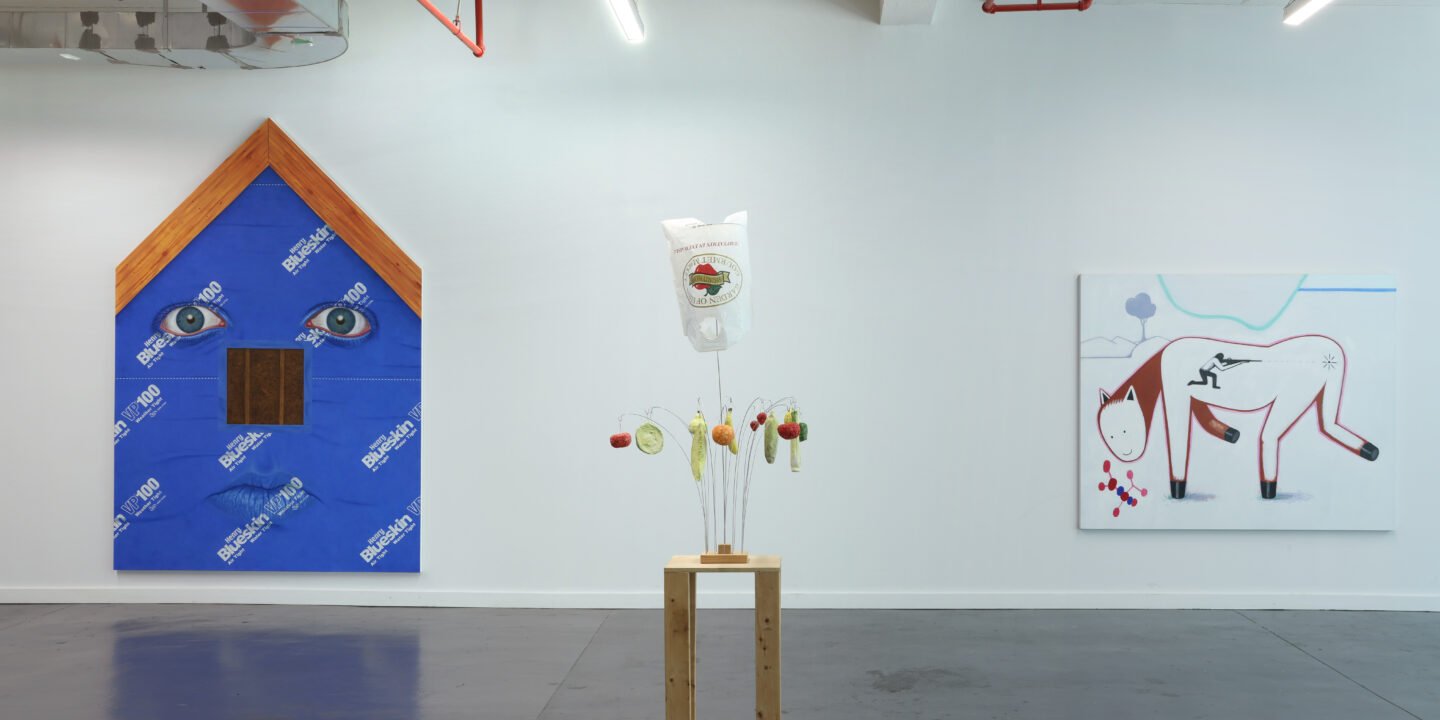
The artists included here cluster into three loosely overlapping generations. The oldest group is represented by B. Wurtz and David Humphrey, who work within a Post-Minimal and Post-Conceptual lineage. They resist becoming spectacles, but have great senses of humor. Humphrey shows afternoon stroll (2024), a painting of an anthropomorphic horse containing a figure of a sharpshooter, whose fire seems to puncture the horse’s haunches to create its butthole. Meanwhile, the horse smiles at a pink fractal on the ground. Sensitivity to the medium allows the canvas to work almost as graffiti on a wall, using just these minimal gestures to take us along for a conceptual but humorous walk. In a 2015 untitled sculpture, B. Wurtz creates an almost lifeless still life with plastic bags and painted fruits suspended on slender wires, all mounted on a wooden box. Here Wurtz comments ironically on the wastefulness of our consumption cycle while providing a conceptual homage to Marcel Duchamp.