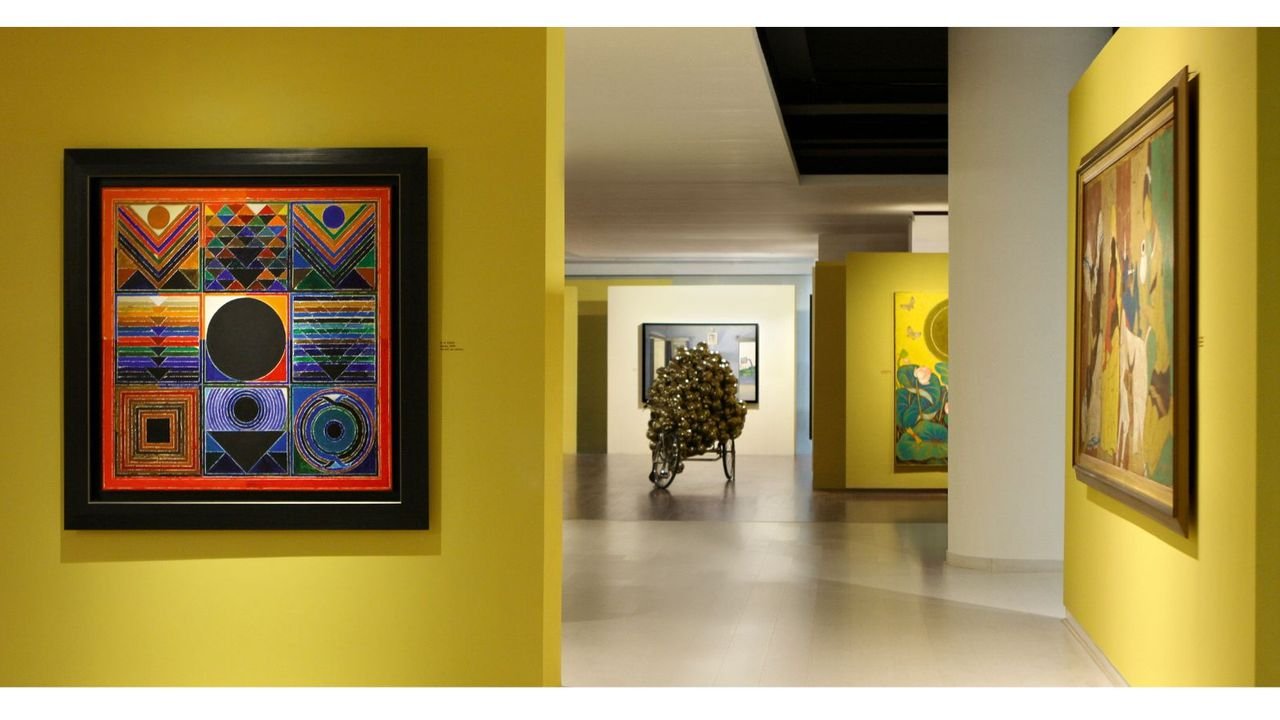
As is often the case with public-facing collections, Nadar started her journey collecting for herself. She soon realised that she wanted to share her collection more broadly. In 2010, she created the Kiran Nadar Museum of Art (KNMA) in Delhi. At its inception, the museum comprised some 500 works. By 2024, this number was in the range of 13,000, making it encyclopaedic in scope and ambition. Soon, KNMA will move into a new one-million-square-foot building in Delhi, designed by Adjaye Associates—a landmark moment for India’s cultural landscape.

Beyond collecting, Nadar has provided philanthropic support for an enormous number of exhibitions, residencies and publications. Her impact is felt not only in India but across the global art world through presentations of, or in dialogue with, art from South Asia. A prime example of this is KNMA’s repeat presence at the prestigious Venice Biennale.
It is no exaggeration to say that the cumulative effect of Nadar’s involvement in collection-building, hosting exhibitions and philanthropic endeavours has fundamentally shaped the direction and tendencies discernible in Indian art over the last 15 years or more. As an example, the resurgence of interest in the art of Himmat Shah is directly attributable to KNMA’s landmark 2016 show, Hammer on the Square: A Retrospective (1957–2015), curated by the museum’s director and chief curator Roobina Karode. Whether it is an increase to the values of key works by blue-chip artists, the potential for contemporary artists to dream of making monumental works or the confidence of galleries to show those works, the “Kiran Nadar effect” is palpable at all levels of the arts ecosystem.