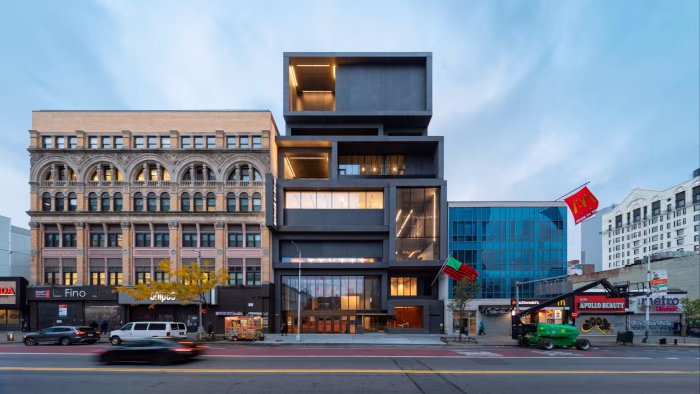
Some museums make themselves graciously inconspicuous, letting art touch viewers with minimal distraction. Others dramatise their contents by draping them in architectural spectacle. The new-look Studio Museum in Harlem takes a third way: it seems to tolerate the collection as a slightly irritating blemish on the purity of its design.
The museum has reopened in the same spot on West 125th Street that it occupied for decades, but you might mistake its brooding concrete stack, designed by Adjaye Associates and Cooper Robertson, for a completely different kind of entity — a trendy philanthropy or a tech incubator, say. This is no longer the scrappy little institution that opened above a liquor store in 1968 nor even the one that later took over an abandoned bank, filling it with contributions from Black artists whom the big museums all but ignored. Many of the Studio Museum’s protégés, and its director Thelma Golden, are now at the heart of the establishment, and the building eloquently expresses all that hard-won stature and permanence. It’s less obviously a great place to commune with art.
David Hammons’ American flag in the colour scheme of the Pan-African flag hangs over the sidewalk. Inside the front door, Glenn Ligon’s “Give Us a Poem” alternately flashes “Me” and “We” in neon, echoing the impromptu two-syllable verse uttered by Muhammad Ali at Harvard in 1975. Those two large but laconic gestures are all the visual joy you get until you’ve penetrated deeper into the grimly coal-coloured concrete environment. There are lobbies in corporate skyscrapers with more visible public art programmes.


As you enter, you’re offered a choice of directions. The first takes you to the basement, down a grand set of bleachers of the kind that has proliferated in trendy architecture: at the High Line, the 53rd Street branch of the New York Public Library, and anywhere that able-bodied youths are encouraged to lounge. The second option heads up a grey ribbon of staircase that curls through the atrium to become the looming centrepiece of the design. This was always going to be a vertical experience; for anyone with wonky knees, architect David Adjaye has turned it into a gruelling one.
A third, less obvious alternative involves hunting for the elevator, which is off to the right and around a corner. There, a wall of pictures distracts you while you wait. This is the first hint you get of the place’s vibe, excitement and creativity: a multi-tiered jumble of photos, prints, drawings and paintings crammed salon-style into the narrow hallway.
The good stuff starts upstairs and towards the back of the building, where a small but rich portion of the permanent collection spreads across two levels, plus assorted niches and landings. A series of thematic mini exhibitions lay out the unstated proposition: whatever you think Black art is, it’s really so much more. Abstractions, portraits, political messages, sound works, hyper-realistic sculptures, pieces that are explicitly political and others that are political if you think they are — the museum’s range is vast enough that it almost lets you forget it has a focus.

Beneath all the stylistic variety lies the ever-changing theme of Blackness. In the monochrome surroundings that Adjaye has supplied, Norman Lewis’s “Bonfire” (1962) appears more incandescent than ever, a red-orange heart with a sapphire nugget at its centre scorching through a sky-blue membrane. We could be staring at a sun, a riot, a celebration, or (in the text panel’s interpretation) a violent ritual of the KKK. Which of those you see depends more on the viewer than the viewed. Much of the work here, like Lewis’s sort-of-landscape, spins out from a representational genre. Senga Nengudi’s “RSVP V” (1976), a wall-mounted sculpture made of stretched brown pantyhose, evokes the prurient exaggeration of a female nude: skinny, faceless, spreadeagled and upside-down.
In Emma Amos’s “Baby” (1966), a woman in a flimsy top and dark shades stands before a cornucopia of brilliant hues, like an explosion in a candy store. Where there’s joy, there’s anger, and the painting reads as a raucous retort to some high modernists’ obsessions with whiteness. (See Jasper Johns’s “White Flag”, Agnes Martin’s “White Stone” and Robert Ryman’s white everything.) “Every time I think about colour, it’s a political statement,” Amos once said. “It would be a luxury to be white and never to have to think about it.”

Adjaye has thought about colour, too, and the answer is always the same: a palette that ranges from sombre to funereal, with touches of timber. He’s been invisible amid the reopening hoopla: two years ago, allegations of sexual misconduct, which he denies, nearly torpedoed his practice. Clients all over the world turned their backs on him, and though the Studio Museum formally distanced itself from him, the design was too far along for them to switch firms. And so his aesthetic sits heavy on the collection. The dark concrete, space-hogging staircase, long and skinny corridors, a roof terrace shadowed by a bridge like a highway overpass, a skylight encased in a pointy, yet pointless structure — all these ungainly quirks have a tendency to intrude on the art.
Still, the museum has doubled its gallery space, so it can narrate a more nuanced and complicated story than before. Disparate works talk to each other through walls and across periods and genres. Portraiture in all its permutations runs through the collection, defying stereotype and invisibility through the force of personality. In Jennifer Packer’s 2013 painting “Ivan”, a young man in a plum-coloured shirt slouches contemplatively in a cloud of mauve brushstrokes. He’s in a mood, his thoughts irradiating the world around him so that limbs go fuzzy and the border between body and air dissolves.


Isaac Julien’s plaster and urethane sculpture “Incognito” (2003) is as precisely realistic as Packer’s oil is dreamy, but it’s charged with a similar spirit of fantasy. It’s a prop from Julien’s short film “Baltimore”, in which the filmmaker Melvin Van Peebles, dressed in a fedora and blue pinstriped suit over a red T-shirt, ambles through the city and meets a life-sized replica of himself wearing the same hat, suit and shirt. The deadpan meets the uncanny.
And in a window nook at the end of a hallway, Barbara Chase-Riboud’s “Cape” (1973) conjures a bodiless Cleopatra from a robe of metal tesserae and blond tresses falling to the floor like ropes. What unites these works by Lewis, Amos, Packer, Julien, and Chase-Riboud is that they occupy a zone where reality and abstraction intertwine. Their creators remade the world as they imagined it, and refused to let the Black man or woman vanish into mist.

Noah Davis’s “Black Wall Street” (2008) captures the tension binding fantasy, pride and dread. The title refers to an island of Black prosperity in Tulsa, Oklahoma that was shattered by a rampaging white mob in 1921. Davis’s strangely ruminative scene conflates the before and after of a cataclysm: a bomb is suspended in the stormy sky, and already its victims lie sprawled on the ground. Untamed greenery surges up from the earth to enfold a still immaculate domed house, with its two caged peacocks guarding the estate. That unease runs through the collection: disaster is always about to strike; disaster has always just struck, and most of life takes place during the surreal moments in between.
I wonder what that sense of the provisional portends for the institution, which has new money, new digs, new prominence and new burdens. The art market and major museums have accepted its arguments, rewarded its risks and co-opted its agenda, thereby potentially undercutting the urgency of its mission. On the other hand, the cultural diktats flowing from the White House are explicitly hostile. So where does the Studio Museum go from here?
Find out about our latest stories first — follow FT Weekend on Instagram, Bluesky and X, and sign up to receive the FT Weekend newsletter every Saturday morning