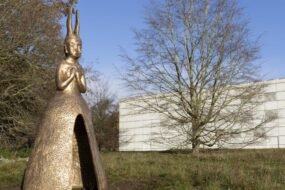
In the mid-1960s, when Maltese sculpture remained largely faithful to marble, stone and bronze, Toni Pace (1930-1989) did not simply introduce a new material; he introduced the constructivist idiom into Maltese sculpture. His welded metal sculptures, executed between 1964 and 1966, remain among the boldest proposals in the history of Maltese modern art.
The constructivist idiom had already transformed sculpture internationally. From Pablo Picasso’s collaboration with Julio González to the welded constructions of David Smith and Anthony Caro, metal had become synonymous with modernity. As Smith observed in the 1950s, iron and steel carried with them the associations of power and progress. Metal had little art history; it belonged to the present. Welding, on the other hand, was a technique derived from engineering and industry and signalled a decisive break with the past. It eliminated the casting process and replaced modelling with cutting, joining and constructing. Sculpture began to approach what art critic Clement Greenberg described as pure architecture.
Malta, however, had not yet absorbed this shift. Pace was among the first of his post-war generation to encounter welded sculpture firsthand during his studies at the Bath Academy of Art in the United Kingdom. There he witnessed the awakening of British sculpture in metal, particularly through artists such as Lynn Chadwick and Barbara Hepworth, who had inherited and transformed Picasso and González’s procedures. From this experience, Pace absorbed constructivist ideas and methods, developing what might be described as a uniquely Maltese constructivist poetics.
Upon his return to Malta from the United Kingdom, between 1964 and 1966, Pace produced 35 welded metal sculptures in mild steel. These works are striking for their geometric clarity. Flat sheets of mild steel were cut and welded directly together. Form was not modelled but constructed. In the Maltese context, these works can only be described as sculpture of the boldest avant-garde: sculpture as object, manifesting itself with the clarity and discipline of scientific engineering techniques.
Yet Pace’s metal works were never exercises in formalism alone. What makes them extraordinary is the dialectic they sustain between indigenous Maltese references and avant-garde geometric pursuits. Rather than abandoning local subject matter in favour of international abstraction, Pace integrated Maltese cultural elements into a constructivist sculptural language. The result is a distinctive blend in which Maltese identity and geometry coexist.
Sea-urchins, cacti, prickly pears and watermelons – elements intimately tied to the Maltese summer – become vehicles for geometric exploration. Thematically, these four elements operate collectively as an aesthetic articulation of Maltese identity. Formally, however, they are subjected to a rigorous process of abstraction that speaks the language of Constructivism. Through this interplay between culturally resonant motifs and disciplined geometric construction, Pace thus fuses Maltese iconography with a distinctly modern sculptural language.
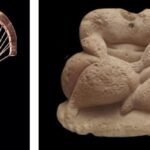
Nowhere is this fusion of Maltese identity and geometry more compelling than in Woman with Faldetta. In contrast to the organic realism of earlier representations of women wearing the traditional Maltese head-dress, Pace strips away physiognomy and retains only structural essentials. The għonnella is reduced to a semi-elliptical arc supported by thin rods. The female figure beneath it is stripped to essentials: an oval head, a simplified torso, the absence of arms. The figure becomes less an illustration of costume than an allegory of identity reduced to its architectonic core. The emphasis is on the essence of things against a mere imitation of external surface. In doing so, Pace transforms a folkloristic emblem into a universal symbol.
This universalising impulse culminates in Fertility Goddess. Drawing inspiration from Malta’s prehistoric figures, Pace abstracts the corpulent limestone form into a rigorous geometric configuration. He captures the formal characteristics of the prehistoric artifact – its volumetric emphasis, its frontal presence – but reduces them to structural formation. The goddess becomes a plastic symbol, abstracted to essential elements, aiming at a universal and permanent representation. Pace’s geometric metal works thus reveal a means of transforming the particular into the universal.
In this respect, Pace’s philosophy aligns, unexpectedly but convincingly, with the aspirations of Piet Mondrian, who advocated the reduction of natural forms to their constant elements in pursuit of aesthetic purity and a spiritual understanding of the universe. Mondrian believed that abstraction was a path toward spiritual understanding and universal harmony. Although Pace never entirely abandoned figurative reference, his trajectory in metal moves toward this same universalising impulse. The Maltese fertility goddess, the għonnella, the sea-urchin or watermelon are all distilled into geometric principles that transcend their immediate cultural specificity.
Pace had recognised this universal emotion of beauty, and while he remained anchored to the figurative, he adhered to the abstraction process as a process of purification, setting aside the particularities of appearance to seek expression in geometrical forms abstracted from the figurative. In doing so, he forged his own path toward a pure articulation of the universal element in art. He was therefore not simply fusing elements of Maltese culture with the sculptural technologies he encountered while studying abroad. More significantly, he was committing to abstraction’s universalising impulse, distilling Maltese cultural references into geometric principles that translate identity into universal form.
In terms of materiality, Pace’s approach was equally uncompromising. Unlike sculptors who manipulated surface texture for pictorial effect, Pace left his steel untreated. The raw metal, subject to oxidation and rust, retains an anonymous directness. The emphasis is on clarity of structure rather than expressive surface. In this, he stands closer to the stark material honesty of Alberto Burri or Smith than to the organic modelling of his British contemporaries, such as Chadwick. The crudeness is deliberate. It affirms the sculpture’s material truth and rejects illusionism.
Significantly, this brief metal phase coincided with Malta’s decade of independence. Pace’s shift from traditional materials to iron and steel, as well as his transition from sculpting to cutting and welding, can be read as a response to the struggle of articulating a new national identity. Yet this very gesture, intended as a renewal, was perceived by some as a threat. The industrial aesthetic seemed alien, even destabilising, within a culture anxious about preserving tradition.
The irony is that Pace’s sources were profoundly indigenous. His works were not imitations of foreign models, but bold statements forged from Maltese experience. By wedding popular and folk elements to engineering modern techniques, Pace resolved in his own way the post-independence dialectic between tradition and progress. His geometric abstraction encapsulated Maltese identity within universal principles, making the local resonate beyond itself.
Today, Pace’s metal works remain a testament to an artist who believed that a new nation required a new language. His welded sculptures were a passing phase in his wider oeuvre, perhaps curtailed by the apprehensions of a conservative audience. Yet their impact remains enduring. In those 35 sculptures, Pace demonstrated that Malta could fully participate in the avant-garde of its time. He proved that abstraction was not a denial of heritage but a means of fixing identity into absolute, architectonic form.
Rowna Baldacchino is a Maltese art historian and cultural critic with postgraduate specialisation in art history, literature, and translation, focusing on modern and contemporary art in Malta