Fabio Orazzo should have been on his way home to Naples for the weekend. Instead, curiosity kept him in Rome, where he teaches art and history, long enough to jump on a bus to visit a little-known church in the north-east of the Italian capital.
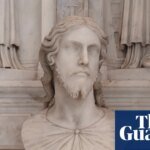
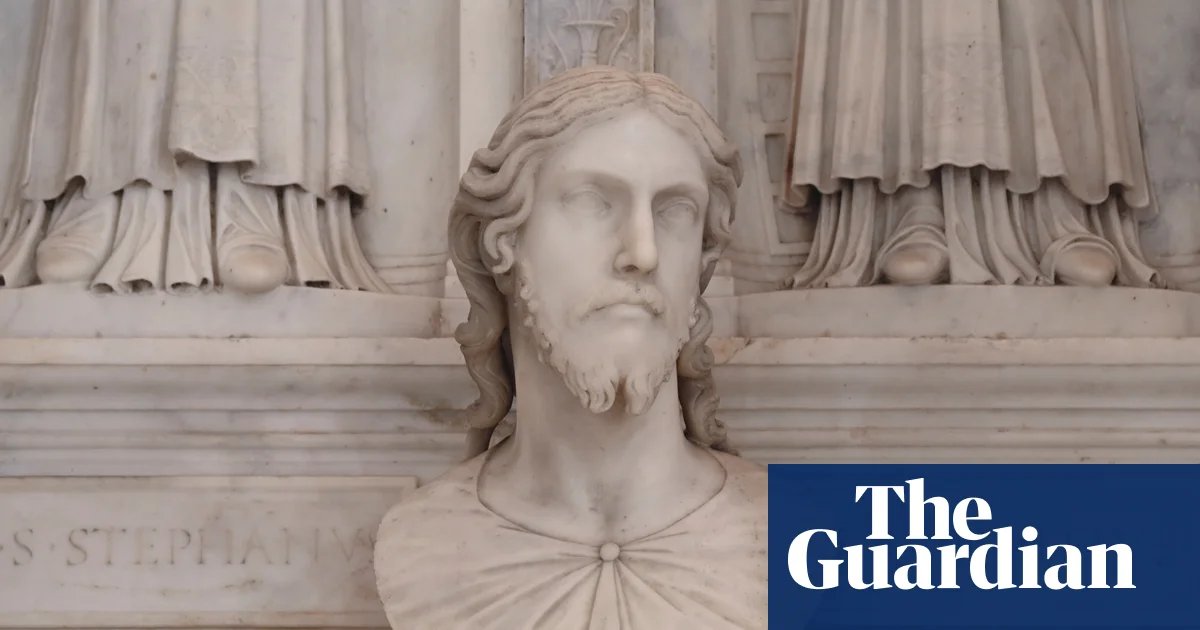
He came to Sant’Agnese fuori le mura (St Agnes Outside the Walls), built above fourth-century catacombs, to see a marble bust depicting Christ the Saviour. A fixture in the church since 1590, it has been thrust into the spotlight by the bold claim that it could have been sculpted by Michelangelo.
“I read about it in the news and decided I must come to see it,” Orazzo said while examining the sculpture on the altar of a side chapel. “I’ve read all the cynical comments and comparisons to Cristo della Minerva, the Michelangelo statue in another Rome church. They say this bust isn’t the artist’s style. But perhaps they were made in different periods of his life and so in my humble opinion, this is a Michelangelo too.”
Orazzo was among a steady stream of visitors to the church since Valentina Salerno, an independent researcher, claimed during a press conference last week that newly discovered documents linked the bust to Michelangelo. The announcement caused a stir in the art world, especially since a sketch attributed to the Renaissance master – but dismissed by some as a copy – sold for £16.9m at a Christie’s auction in London on 5 February.
Salerno, a fiction author and actor, is the first to admit she “is not an art historian”. Neither did she finish university. But, she said, her three years at law school were “very useful” because they equipped her with the skill and tenacity to “read these notary acts, wills and inventories with a legal eye”.
For more than a decade, she has sifted through records in Italian and Vatican state archives in pursuit of details about the final days of Michelangelo’s life in Rome, where he lived for roughly 30 years until his death in 1564.
“I found it impossible to believe that nobody had studied the last days of his life in a deep way,” said Salerno, who published her findings on academia.edu, a non-peer reviewed website used by academics. “There are so many mysteries.”
Salerno said her most revealing discovery was of documents about a secret room, locked with multiple keys, in which the artist had ordered his close associates to stash some of his drawings and sculptures – apparently including the Christ the Saviour bust. This challenges the long-held theory that Michelangelo had burned his works before he died.
Salerno claims Michelangelo’s goal was to hide his treasures from relatives he detested in Florence and for them to be passed on for future study.
The documents showed that the room was later emptied and its contents transferred to religious institutions and other sites. As a result, Salerno believes there could be about 20 unknown Michelangelo works.
She thinks the bust bears a resemblance to Tommaso dei Cavalieri, a young nobleman Michelangelo was infatuated with.
Adding credence to her claims is documentation following Michelangelo’s death that attributes the bust to him. The sculpture attracted much discussion in the 18th and 19th centuries. The British painter JMW Turner sketched it during a trip to Rome in 1819 and the German sculptor Emil Wolff made a copy now kept at the Charlottenburg Palace in Berlin. The French writer Stendhal also wrote that he believed the bust was by Michelangelo.
However, the attribution was debunked by a scholar in 1984 – incorrectly, according to Salerno. Since then, the bust has been categorised by Italy’s culture ministry as being by an unknown sculptor.
Salerno’s research has the backing of the St Agnes church. Franco Bergamin, the abbot of the Catholic order that runs the premises, said during the press conference: “We have lived here since 1412, and the monumental complex of St Agnes always holds surprises – this is one of them.”
However, the Italian culture ministry did not respond to an invitation to the press conference and nor did Mauro Gambetti, a cardinal who appointed Salerno to a scientific committee last year aimed at creating a Vatican exhibition to mark the 550th anniversary of Michelangelo’s birth. Committee members approached by the Guardian, including Hugo Chapman of the British Museum, declined to comment.
Francesco Caglioti, a professor of medieval art history known for his in-depth studies of the Renaissance and Michelangelo, said Salerno’s research was “very useful” and “should be developed” but he categorically ruled out the bust being by Michelangelo.
“I have encouraged Valentina as she is looking into a part of Michelangelo’s legacy which has never systematically been studied,” he said. “But, as I told her, I did not expect her to make such an attribution. This bust is not a Michelangelo. It does not have his style, but above all, it does not have his quality. Perhaps it was sculpted under his watch, but it is not by him.”
Salerno has invited experts to “provide documents that dismantle my theory” and to scientifically appraise the attribution. “I don’t have the technical capabilities to say 100% that it is or isn’t a Michelangelo,” she said. “It could be plastic for all I know. I’m being attacked as some kind of charlatan but all the documents point in this direction.”
As the bust’s authenticity is debated, Italy’s art police are taking no chances. Security around the sculpture has been tightened and a laminated sign reads: “Alarm armed”.
Gori Magnani travelled to the church with her husband from a town near Rome specifically to see the bust. “I find it fascinating,” she said. “Maybe it is a Michelangelo. Either way, this research should be supported and scientific experts should establish whether it is true or not.”