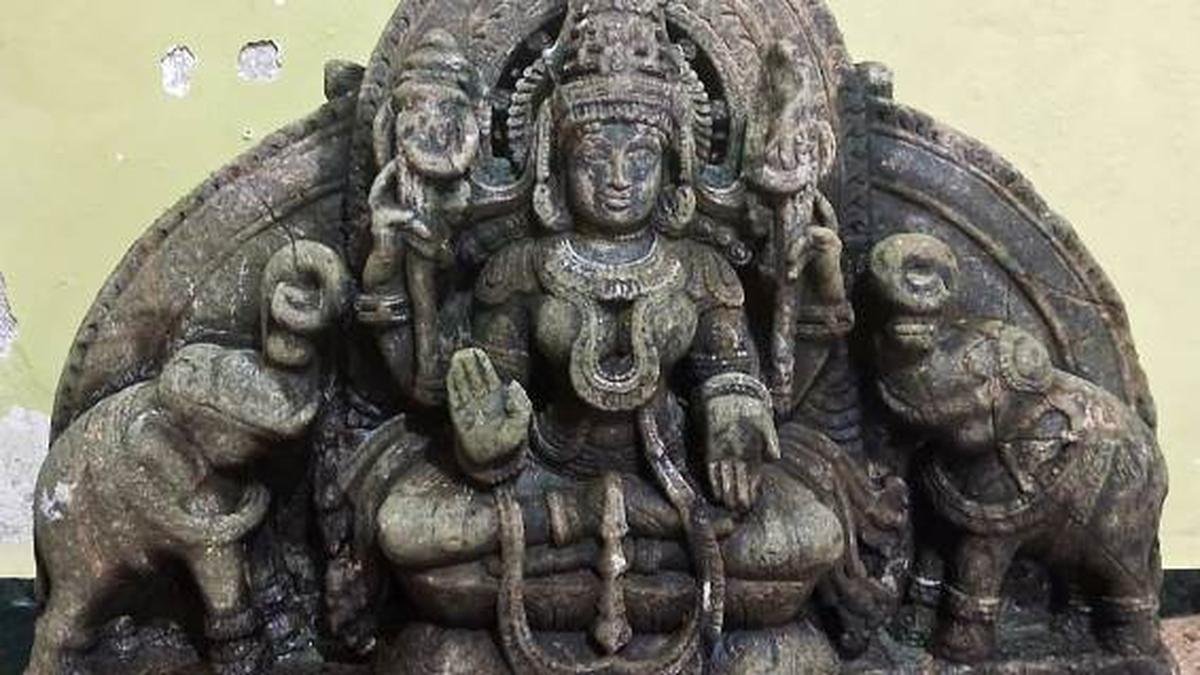
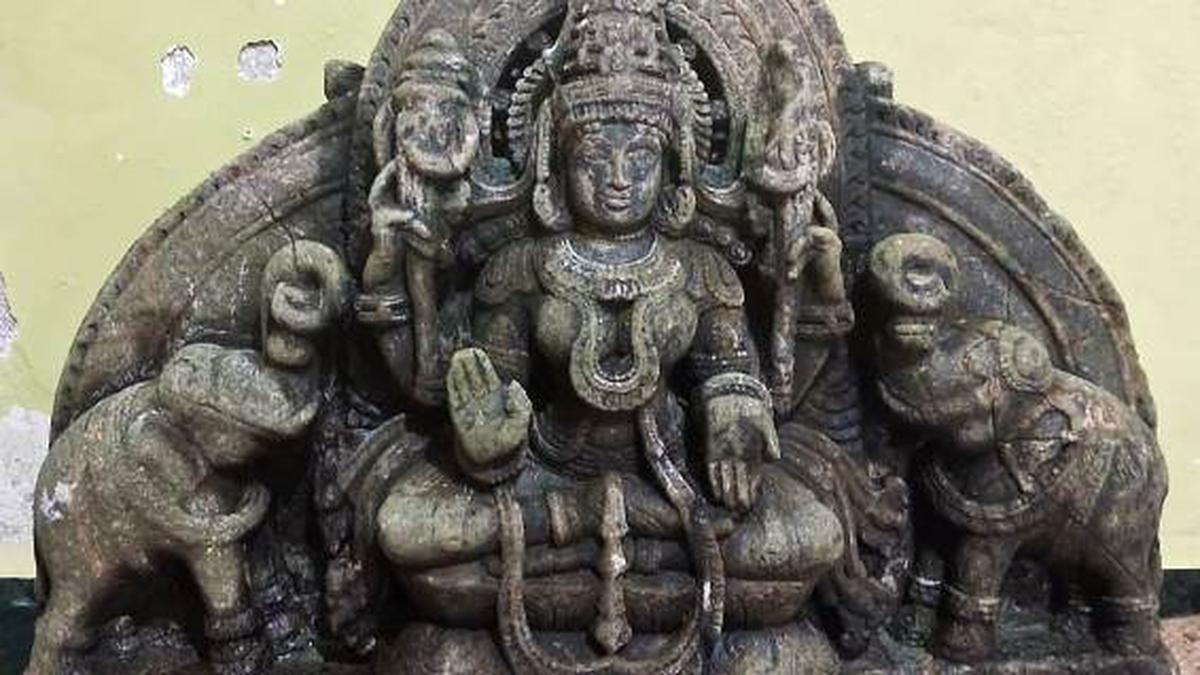
An ancient Gajalakshmi sculpture was found in Sattari taluk of Goa
| Photo Credit: special arrangement
A unique sculpture of Gajalakshmi, which stylistically belongs to the 10th century AD, was found in Valvanti river at Parye near Sattari Keri, in Sattari taluk of Goa, said founder-trustee of Udupi-based Adima Kala trust T. Murugeshi.
In a press release, Mr. Murugeshi, retired associate professor, Ancient History and Archaeology, MSRS College, Shirva, said the sculpture is about 50 cm in length and 61 cm in width.
Gajalakshmi, he said, is found seated on a lotus pedestal in a calm and divine expression with four hands. She appears to hold a lotus bud in the upper right hand and in the upper left hand. There are makarakundalas in her ears and a beautiful head gear in the form of three-tiered Karanda Mukuta or kirita with a canopy.
There is also a oval shape Prabhavali with Simha or lion lalata at centre. She is flanked by two elephants with sacred kalashas. Gandaberunda, the mythical animal, is found in the centre of pedestal in floral form.
The sculpture under study, he said, has great historical significance. He said he has noticed a number of Gajalakshmi panels in sacred forests and outside many temple premises, which represent war scenes and Lakshmi in tribal form. The Gajalakshmi sculpture under study represented the greater tradition of Vaishnava cult. The Gandaberunda was the royal emblem of the Kadambas, Vijayanagar, Wodeyars of Mysore and has been the emblem of Karnataka.
The sculpture has been preserved by trust’s president Rajendra Kerkar, Mr. Murugeshi stated.
Published – October 23, 2025 08:34 pm IST