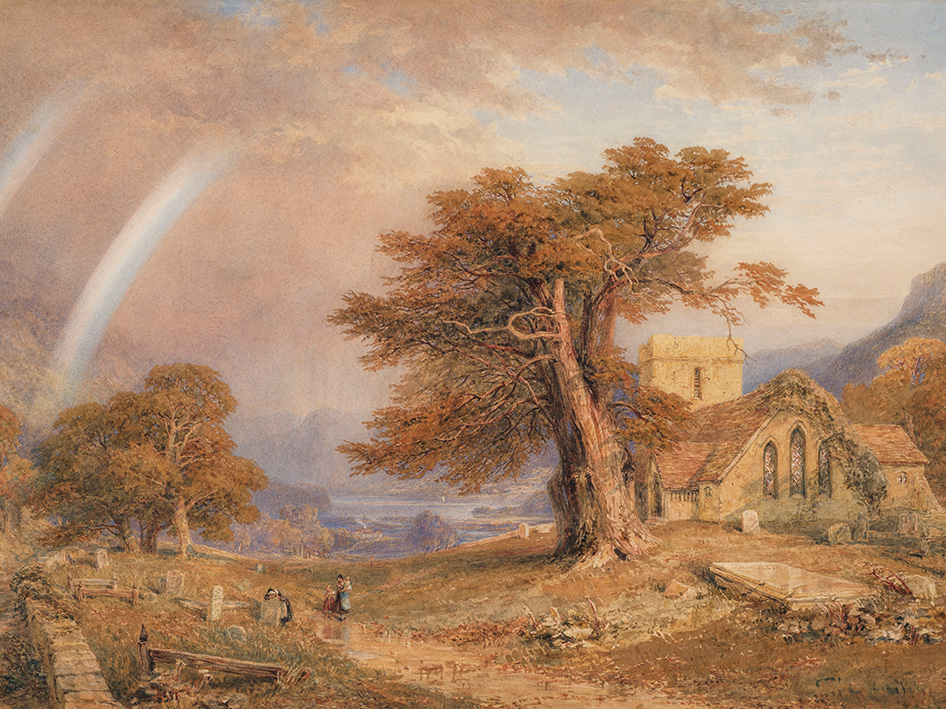
The long-standing narrative of British art states that this nation emerged as a serious artistic force only in the 18th century, when we discovered and colonised our own specific genre. Not for us grand depictions of classical antiquity or biblical scenes but something more quotidian, as befitted a pragmatic, democratic race with just a flutter of the numinous in our Protestant souls: landscape painting, and in particular landscapes in watercolour. In no other country at the time was the urge to paint the natural world so strong or so widespread. And no other country could boast a lineage of artists to match Gainsborough, Turner, Constable, Thomas Girtin, John Sell Cotman, John Robert Cozens, Paul Sandby, Francis Towne, et al.
This roster is strikingly male – not a single female artist is regularly cited among these fabled Georgians. The most celebrated female landscapists – a relative term – did not emerge until the Victorian age; even then Barbara Leigh Smith Bodichon was better known as a women’s rights campaigner, and Helen Allingham as a painter of cottage idylls rather than sweeping vistas.
Nevertheless, it should come as no surprise that as the men whipped out their brushes to put down on paper the majesty of the Lake District and the Alps or the serenity of British parkland and rivers, female watercolourists were dabbing away too. After all, watercolour was an approved “feminine” medium, unlike messy and physical sculpting or the technical complications of oil paint with its necessity of having studied figure drawing (a training closed to women). It is this forgotten or never recognised group that is the subject of a small but intriguing exhibition at the Courtauld Gallery, “A View of One’s Own: Landscapes by British Women Artists 1760-1860”.
It was only two years ago that “Now You See Us” at Tate Britain disinterred a long history of native female artists, and the 1760s was the decade they started to come to the fore. Two women painters, Mary Moser and Angelica Kauffman, were among the original Royal Academicians at its foundation in 1768, albeit that it took more than a century until further women were admitted. And in 1764, two other figures were the first women to exhibit original landscape works in London.

New year, new read. Save 40% off an annual subscription this January.
At the annual exhibition of the Society of Artists of Great Britain a Miss Gardiner showed A View of Scarborough, Taken on the Spot, while an anonymous “young lady” exhibited A View of Battersea Church from Chelsea. Neither painting is thought to have survived and nothing more is known about either painter (the only Gardiner listed in The Redgrave Dictionary of British Artists, 1878, was William, an engraver, who wrote some “sophistical reflections on the pains of life and the sweetness of death” before killing himself).
Over the next few decades hundreds more women were to follow the example of Miss Gardiner and the “young lady”, either as exhibiting amateur artists or professionals. One recent scholar has calculated that women represented some 8 per cent of all landscape artists actively exhibiting in Britain between 1780 and 1850 – a modest percentage perhaps but a still significant overall number. Some were accomplished enough to stand out from the mass of male artists and catch the eye of reviewers: in 1810, for example, Amelia Long (later Lady Farnborough), was commended by the Examiner: “Few male Artists exhibit such firmness of hand, none more taste and judgment in the distribution of her lights and shades.” Nevertheless, there is no proper critical literature around her or the majority of her peers.
Long was not the only female artist to earn a regular place on the Royal Academy’s walls. Maria Pixell showed 31 works there between 1793 and 1811; Amelia Noel presented 15 landscapes; and in the first half of the 19th century Harriet Gouldsmith exhibited more than 200 landscapes at various institutions. Meanwhile, no fewer than six daughters (and one son) of Alexander Nasmyth followed their father into landscape painting, exhibiting in both England and Scotland and teaching at the family art academy.
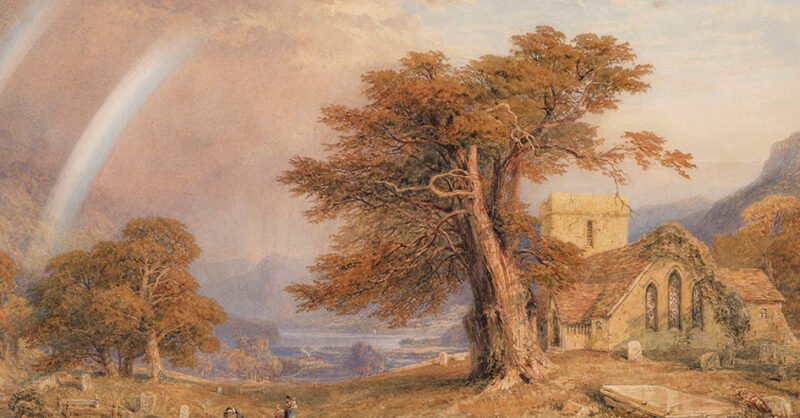
The 35 pictures in the Courtauld exhibition show there was no such thing as feminine landscape sensibility; all are essentially indistinguishable from the views painted by a legion of male artists, both ranging from the conventionally attractive to the awe-inspiring. But then, male and female artists alike were influenced by the landscape theories of the time, notably those of Edmund Burke and William Gilpin, which suggested that Britain’s rugged places were far from being “eminent only for being the wildest, most barren and frightful of any that I have passed over”, as Daniel Defoe described the Lake District in the 1720s, but thrilling, frisson-filled and a fit and proper subject for artists.
Mary Lowther (1738-1824), the most distinctive artist on show, already knew this. The daughter of the Tory prime minister the Third Earl of Bute, she married the landowner and coal magnate, the First Earl of Lonsdale. It was a deeply unhappy union and Mary spent much of her time at Lowther Hall, south of Penrith, drawing the local landscape. Between 1765 and 1766 she made 91 watercolours, the most complete record of the Lake District to date. Among them were two paintings here, worked up from drawings made on the spot, showing the Neolithic stone circle Long Meg and Her Daughters. Just as Constable was to do with Stonehenge in 1835, they are notable for a strong graphic presence and an alertness to how the stones change in appearance with fast-moving weather.
And as JR Cozens and Richard Wilson headed to the continent and painted the Alps and Castel Gandolfo, so too did Elizabeth Frances Batty (1791-1875) who travelled to Italy in 1817 and made a series of detailed landscape drawings that were later engraved and published, to great success, as Italian Scenery. They were also used to decorate Staffordshire pottery meant for the American market.
Not all the artists in the exhibition had this level of accomplishment. The attempts of Richenda Gurney (1782-1855) to give the cliffs near Torquay a craggy grandeur are at best maladroit while Landscape with Figures and a Distant View of Rome (1776) by Eliza Mary Gore (1754–1802) is an ersatz pastiche mixing Raphael, Claude and the Dutch Golden Age painter Nicolaes Berchem to unhappy effect. Along with the better-known male painters, enough of their work exists to be able to judge whether an unsuccessful painting is nothing more than a slip in quality. But with the more obscure women artists, it is hard to know whether such pictures are aberrations or the best they could do.
None of the ten artists in this little exhibition threatens to overturn the dominance of the famous men, however a couple – Mary Lowther and Fanny Blake (1804-79) in particular – were clearly gifted beyond the normal scope. And none of the men had to face the stigma so pithily recorded by Harriet Gouldsmith, who recalled overhearing “the highest praise” bestowed on one of her paintings in an exhibition only then for the commendation to be “in a great measure retracted, when the picture was understood to be the production of a female”.
[Further reading: Choreographer Wayne McGregor: Art should not fear technology]
Content from our partners