Timber-framed houses lean toward quiet lanes, gardens spill over low fences, and beyond the rooftops stretch fields that have changed little since medieval times.
Yet this peaceful place once became an unlikely centre of modern British art — a haven where creativity flourished far from the city.
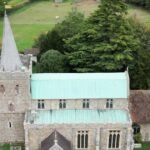
The village’s history reaches back centuries, visible in its listed buildings and in the ancient parish church of St Mary the Virgin Church.

Dating largely from the 14th century, the church stands with calm authority over the village, its stone walls lit by stained glass that glows jewel-bright on winter afternoons. For generations it has been both a spiritual home and a silent witness to the changing life around it.
In the 1930s and 40s, that life shifted in an unexpected direction.
Artists seeking space, affordability, and community began arriving from London.
Among them were Edward Bawden, whose crisp linocuts celebrated everyday England, and his friend Eric Ravilious, a master of luminous watercolour, who became principal members of The Great Bardfield Artists community group.
With them came Tirzah Garwood, whose witty wood engravings transformed domestic scenes into something quietly radical. Spare rooms became studios; barns filled with presses; neighbours became subjects.
The artists did not isolate themselves from village life — they became part of it.
Exhibitions spilled into homes and gardens, most famously when they opened their houses to the public in the 1950s. Visitors wandered from kitchen to parlour discovering prints beside teacups and paintings above mantelpieces.

Today, spaces such as the The Fry Art Gallery continue that tradition, showcasing the paintings, prints, wallpapers, books, fabrics and ceramics made by the Great Bardfield art community between 1930 and 1970 to art lovers from far beyond Essex.
The creative spirit would echo into later decades.
Turner Prize-winning artist Grayson Perry spent part of his childhood nearby — a reminder that inspiration can take root in quiet places.
Read more: One of the most extraordinary houses in the world in Essex | Gazette
Despite its artistic legacy, Great Bardfield remains above all a living village: a post office, welcoming pubs, a busy hall, and annual festivals that bring residents and visitors together.
It is friendly, unpretentious, and deeply rooted in its landscape.
Perhaps that is why artists came — and why their influence lingers.
Here, amid fields, history, and community, art did not shout. It simply settled in, like evening light across the Essex countryside.