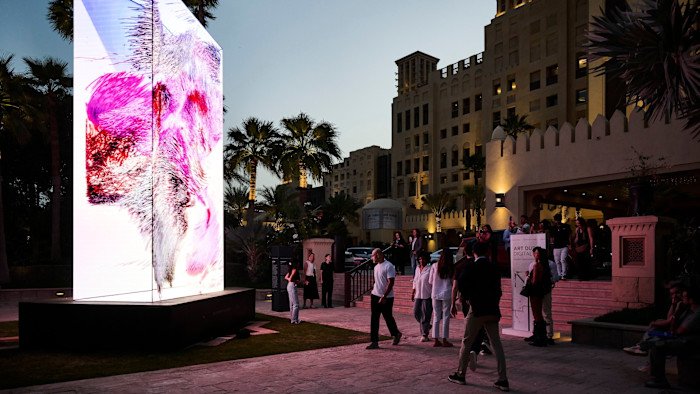
At the start of this year, a survey of art market professionals found the most optimism centred on activity in the Middle East. The region was entering “a pivotal year supported by an expanded calendar of art fairs and auctions”, according to ArtTactic’s Global Art Market Outlook, with 76 per cent of experts backing better sales in the Mena region, far ahead of the dominant US market, at 48 per cent.
Just two months later, the US and Israel launched a war in Iran, with subsequent escalations ranging from oil price shocks to missile and drone attacks on countries now on the art map, notably in the UAE, as well as Saudi Arabia and Qatar. “The landscape has changed dramatically,” says Anders Petterson, founder and CEO of ArtTactic. “A prolonged situation will inevitably impact the Middle Eastern art market, particularly as the regular rhythm of art fairs, exhibitions, and auctions, which are so vital to the region’s ecosystem, could face disruption,” he says.
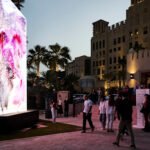
In the immediate term, the timing could scupper the region’s longest-standing fair, Art Dubai, whose 20th edition is set to open to VIPs on April 15. Ben Floyd, chief executive of Art Dubai Group, says that “we are still a month away and still planning a fair. I’m sure some international galleries will drop out, partly because of the logistics, but locally there is a feeling that we should go ahead.”
He acknowledges that “these are difficult times, and not how we were planning our anniversary edition,” adding that “if we don’t think we can be successful, then we won’t do it.” His responsibility, he says, is to the exhibitors who “make an effort to come to a fair. People aren’t going to congregate if they think that a drone will fall on them.” A final decision seems likely to be made once the Eid al-Fitr holidays end early next week.

Some galleries have already withdrawn. “While the conflict is continuing and receiving so much media coverage, I don’t believe people are interested in coming to an art fair from outside of Dubai. The proximity of the bombing is not conducive to buying non-essential items,” says Toby Clarke, director of London’s Vigo Gallery, who decided to pull out of the event soon after the war in Iran began. “The risk reward is just not attractive on any level,” he says.
The safety of his staff was paramount, he says, while he and others point out that getting insurance is tricky. Robert Read, head of art at the insurers Hiscox, says that “sending art to the Middle East is not critical, unlike for example medical supplies, so most people are happy to delay it until the situation stabilises.”
Coralie Zaccar, a Lebanon-based fine art expert for Commercial Insurance and Comin, says that one issue is that, while businesses can take out war and terrorism coverage, “it’s not certain what is happening in Dubai, for example. They are not officially at war, so it’s a challenge to classify.” There are solutions, under business interruption categories, but, she says, at increased premium levels.
Levent Özmen, director of the Istanbul and London gallery Dirimart, says he is “on hold” about his planned booth at the Art Dubai fair. He adds though that such commercial events are not critical to the future of the art market in the region. “Fairs come and go. More crucial is that the Guggenheim Abu Dhabi is supposed to open this year, creating a collection [of modern and contemporary art] from scratch. That’s the drive for us,” he says.
Mariët Westermann, director and CEO of the Solomon R Guggenheim Museum and Foundation, says that their plans to open as the latest museum on Saadiyat Island are “steady as we go, everything is on time and progressing wonderfully.” She adds though that “in a moment of war, we are not focusing on the precise date.”

She and others emphasise the “resilience” of the region. “Since we started planning, in 2005 . . . there have been many shocks to the system,” Westermann says. “The huge financial crisis of 2008 to 2009 and its long aftermath, the Arab uprisings and civil wars, and then Covid. I think we have to keep things in perspective.”
On the ground in Dubai, “we are doing OK, given everything,” says Kourosh Nouri, founding director of Carbon 12. He says that he and other galleries in the city’s Alserkal Avenue cluster have “resumed quasi ‘business-as-usual’ operations” and that “while the drone attacks are terrifying and terrible, there has been no disruption professionally . . . this is not as bad for us as during Covid.”
He believes that the Art Dubai fair should go ahead. “There are strong, internationally active galleries here in Dubai so, once we have adjusted a bit, the 20th anniversary edition could be absolutely marvellous. People here want to go out.”
He accepts that getting some works from further afield into the region could be impossible, given flight delays and cancellations — “we might have to rethink certain aspects,” Nouri says — but notes that many of the artists he plans to show have ties to the region or are based there already. Plus, Nouri says, “some artists have said they will bring works with them on the plane if need be.”
Collectors are showing a similar spirit of community, says Diane Abela, director for the Middle East for the art advisory group Gurr Johns. “I have clients who bought work last week,” she says. “The art world in [the region] is very connected, very supportive, people and institutions feel more responsible [to the market] at the moment.”
Abela notes that the latest excitement about the region’s art scene came about “after more than 15 years of building a very solid infrastructure and ecosystem”. Middle Eastern collectors are “very serious, very rigorous and discreet,” so not going away fast, she says.
Meanwhile, art market observers remain concerned about the longer-term ramifications of the conflict. “A shortlived spike in the oil price tends to create very little economic damage,” says Paul Donovan, chief economist at UBS Global Wealth Management. However, he says, “this cannot carry on indefinitely. If oil prices stay higher for longer, then consumers either have to become much more efficient in energy consumption, or spend less in other areas, or some combination of the two. That then has economic consequences.”
In an already fragile discretionary spending environment, ArtTactic’s Petterson warns that “depending on its outcome and duration, there is a real risk that this conflict could undermine the recovery we’ve been seeing in the global art market over the last six months.”