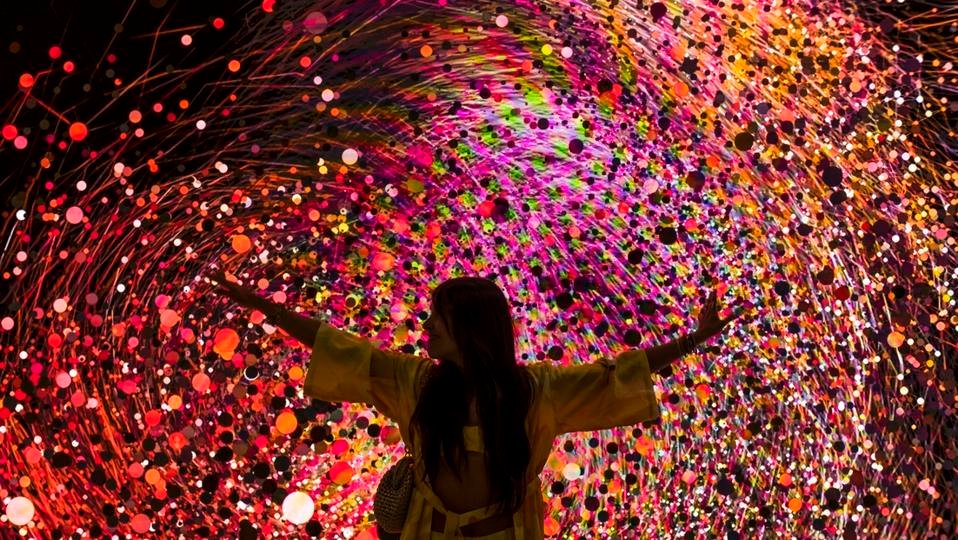
People interact with a large scale digital installation called No Me Olvides by Ix Shells at Art Basel in Miami Beach, December, 2025. (Photo by Christopher Pillitz/ Getty Images)
Getty Images
Digital art spent decades stuck in cultural limbo—ubiquitous in advertising and design, shaping what we saw every day, yet under-appreciated by collectors seeking long‑term value or legacy. That dynamic has flipped. As the post‑Covid art market has evolved, a new generation of collectors is actively embracing digital art in all its forms, pushing it firmly into the realm of serious, collectible work—and racking up serious sales.
While estimates vary, the digital art market is valued at somewhere between $5.5–6.2 billion by market research firms. This is a sizeable chunk of a global $59.6 billion art market, up 4% after two years of contraction, according to the just-released Arts Economics 2026 report for Art Basel and UBS.
In the comprehensive study, a survey of 3,100 high-net-worth individuals (HNWIs) across 10 global markets found that paintings remained the most-purchased medium in 2025 at 67%, while 56% bought a sculpture, aligning with previous years. However, the next most popular segment—“with a large uplift on 2025”—was digital art, with just over half (51%) of the sample making a purchase.
Widely recognized as the first non-fungible token (NFT) artwork was Quantum, a code-based animation by Kevin McCoy, minted on the Namecoin blockchain in May 2014. Though NFTs eventually became heavily over-hyped—with the speculative market peaking in 2021—they helped bring digital artists who had preceded them, into the limelight.
Kevin McCoy’s Quantum (2014)—the first NFT artwork ever minted—on view at Sotheby’s, London in 2021. (Photo by Tristan Fewings/Getty Images for Sotheby’s)
Getty Images for Sotheby’s
This latter category is growing not due to hype or speculation, but changing consumer preferences. As digital in all its forms has become ubiquitous, especially among video-gamers, cinema-goers, and through social media, digital art is now its own category, with the sales to prove it.
Younger collectors—especially Gen Z and Millennials—show an increasing preference for digital‑native work that is both novel and stable. They also have money. At auction house, Sotheby’s, a report called A Century of Surrealism indicates that Millennials have become a powerful force in less than a decade. In 2018, their share of the bidders’ pool for Surrealism was 12.6% but almost doubled to 23.8% in the first half of 2025. Gen Z’s share rose from 0.5% to 6.2% over the same period. These collectors are acquiring works by their peers, but are also older, more established 20th-century artists.
The shift in generational demand is positively helping the digital segment. In its 2025 Art & Finance Report, Deloitte & ArtTactic note that “next-gen collectors are more drawn toward digital art, emerging and experimental artists, and social causes tied to art”. With the Art Basel & UBS study also citing digital art as the third‑largest spending category among influential HNWI’s, growth seems all but assured.
The digital medium was, until recently, treated as peripheral, but has now become an asset class in its own right, and a museum‑validated category. Digital art has moved from online platforms to physical fairs and galleries, and from niche communities to the mainstream.
In the U.K., this became clear when, in 2024, the British Art Fair launched Pivotal:Digitalism, the first dedicated digital art section in a major commercial show. Critics described it as “a peek into the next frontier of art,” and exhibiting visual art agency Kei London said it marked “a significant milestone in the U.K. art scene.” New-media artist Steve Zafeiriou commented: “Digital art is now a driving force in the evolution of contemporary art.”
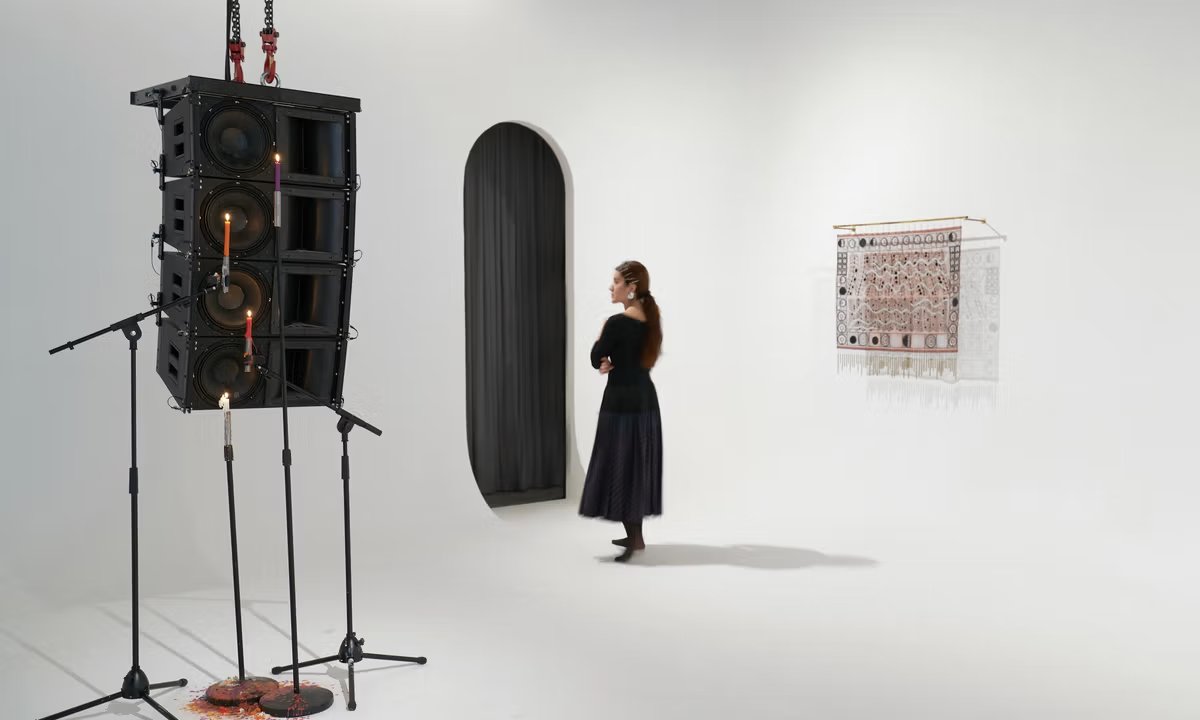
A year later, the fair went further, declaring digital as a new movement—a formal ‘ism’ in the history of art. At the show, Siddhartha Kunti’s olfactory work drew attention thanks to its novel visual expression of different whisky aromas. While digitalism was seen by some as a shrewd sales move, the world’s best-regarded fair, Art Basel, followed with Zero10, a dedicated digital‑art section that debuted in December 2025 at Art Basel Miami Beach. Frieze has also integrated digital and hybrid works into its main program in 2024, and digital sections at several fairs have reported strong sell‑through rates.
Volume sales share below $50,000 has never been higher this decade.
Arts Economics/Art Basel and UBS
Unlike NFTs, that signaled the excesses of crypto culture, digital art’s growing stature has come from the traditional art world’s realization that this form has history and longevity. It is no longer a curiosity, and is reshaping how people buy art, and how they think about value.
Several digital artists are seeing the benefits. One is veteran, London-based VitaliV, represented by MA Gallery. Born in Odessa, Ukraine in 1957 as Vitali Vinogradov, he studied engineering before turning to classical painting in St. Petersburg. Having lived in the famous Apteka Pelya Mansards art squat, he later moved to the U.K. capital where he founded a multimedia art community in up-and-coming Hoxton in the 1990s. There he organized film festivals, conceptual exhibitions, and early digital‑media shows.
VitaliV cleverly coined his own unique term to describe his work that drew from microchips, circuitry, and architectural precision—Schematism. As a signature style, it is a visual language built on clean lines and geometric clarity, but fielding an emotional undertone. It is also very adaptable: his designs can be found on jewelry, scarves, and even tableware.
With a structural change in taste taking place—driven by a generation that grew up with screens—consumers are breaking the hierarchy between digital and physical creativity.
Art Basel & UBS suggest that digital art is entering a post-speculation, mature phase which means collectors are becoming more serious and selective.
Younger buyers are increasingly looking for narrative depth, technical skill, distinctive styles, and track records—in other words stability. The shift is reinforced by broader market dynamics. The Deloitte 2025 report forecasts nearly $1 trillion in art‑related wealth transfer over the next decade; to a generation building collections that reflect their identities—and digital art is a naturally fit.
One of VitaliV’s most popular works: Still Life, 2017
MA Gallery, London
As the market matures, collectors are beginning to look back—not at the speculative years of the NFT boom—but to artists who were working with digital aesthetics long before that.
These creators offer something rare: a combination of historical depth and contemporary relevance. They were experimenting with digital forms in the 1980s, 1990s, and early 2000s, so their work has evolved alongside the technology itself. Even if some avoid AI and continue with old-school tech—a mouse, design software like CorelDRAW, and a computer—their work is often relatable, and price accessible.
VitaliV’s whole collection, including sculptures, was sold at last year’s British Art Fair, marking his best show in several years. His most recent sale through MA Gallery was Still Life, 2025 (acrylic on dibond, 150x120cm) which went for £6,500 ($8,620). Renewed institutional attention of pre-AI digital work by institutions like the Guggenheim Bilbao, Tate, and Whitney in NYC, has also brought other veteran users of digital tools in different media, including Albert Oehlen, Harold Cohen, Mick Wiggins and Nancy Stahl, into greater focus.
These artists can move fluidly between digital and physical formats, enabling their work and creative concepts to transfer from screens to canvases, and even to items such as limited‑edition prints, home décor, sculptural objects, fashion, and to hybrid physical‑digital pieces. While this is not a particular ambition for many artists—or seen on a big scale except in museum shops and drinks collaborations—it can become an extra revenue stream.
As the NFT hype has moderated, collectors still look for innovation, plus aesthetic depth and future value. Digital artists whose works have stood the test of time are back in demand, reflecting a diversified shopper base. Traditional categories still matter as the Millennial interest in Impressionism shows, but buyers are also seeking digital-native work.
In the case of VitaliV, he has described Schematism in stock market terminology in the past. Today, his work could be termed a mid-cap digital asset: analogous to companies that have strong structural foundations, are in a growth phase, and sit between emerging opportunity and established stability. They are neither speculative nor fully mature. Applied to art, the concept could be useful in decision-making when it comes to risk.
Collectors, especially those new to the market, may like this because it bundles aesthetic coherence with practicalities. A Schematism painting can be hung, a Schematism scarf can be worn, a Schematism sculpture can anchor a room. The digital language of an artist can therefore becomes a lifestyle language which has appeal to younger audiences.
With Art Basel & UBS, Deloitte Art & Finance, and others all pointing to the same trend—that digital works are shifting from disruption-led speculation towards consolidation, selectivity and durability—the segment is looking particularly strong. Digital art is growing, retail‑friendly aesthetics are in demand, and artists who can bridge digital and physical worlds—and who have been doing so for decades—are suddenly looking like smart long‑term bets.
This article was originally published on Forbes.com