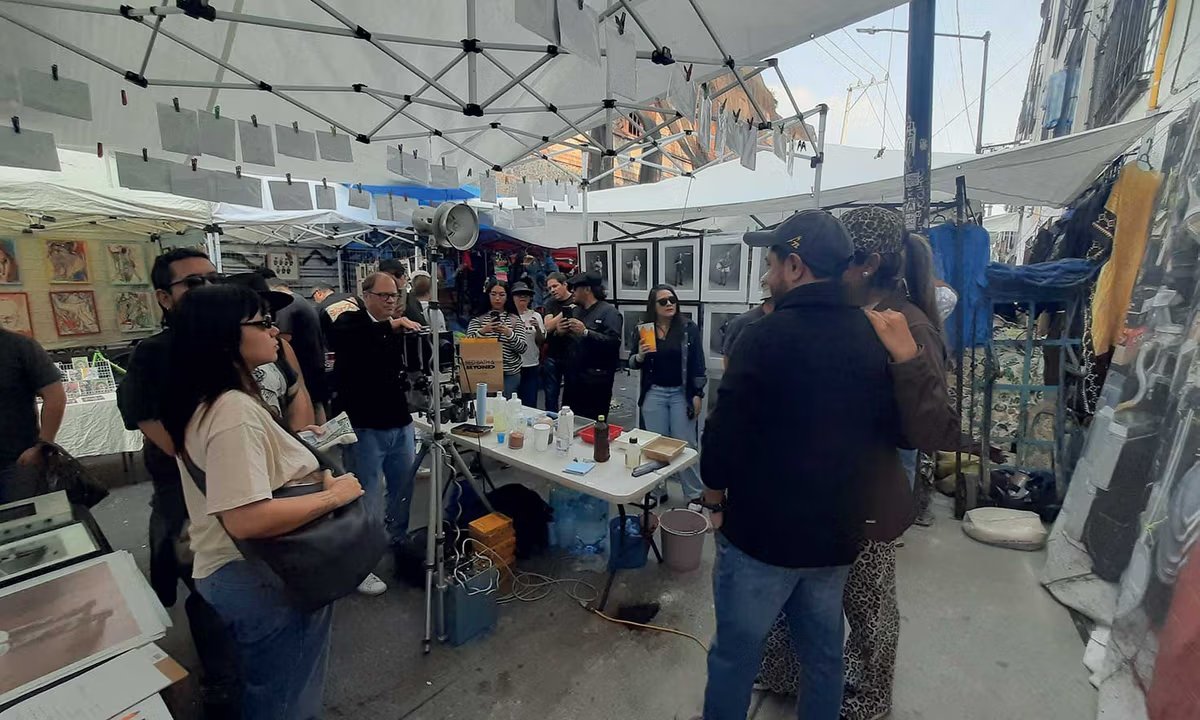
Every Sunday, the street market La Lagunilla—located near Mexico City’s downtown and famous for its antiques and micheladas—becomes home to one of the city’s most interesting galleries, Galería Tianguis Neza. Amid the crowds moving to cumbia, the artist Luis Valverde welcomes curious friends and collectors to discover works sold at precios de tianguis (street-market prices) directly from the artists.
Valverde launched the project at the height of the pandemic, in 2021, to generate income for himself and his colleagues at a critical moment. “We were having a hard time,” he tells The Art Newspaper. “Art is often seen as having only symbolic value, but the economic value is important in any profession. Many times, artists resist participating in the market.”
He launched the gallery, in collaboration with his then-business partner, the artist David Azael, out of a desire to create a commercial setting that would feel comfortable to both artists and casual buyers. The selection of featured artists follows a simple process: Valverde offers space to friends and to artists who ask for an opportunity.
“It’s not about evaluating their work or their achievements,” he says. “It’s more about experimenting with the art market—allowing them to experience selling their work directly to the public, learning how to negotiate and establishing a dialogue.”
Since it launched more than four years ago, Galería Tianguis Neza has gained momentum. On any given Sunday, visitors might encounter artists such as Tania Candiani or Teresa Margolles, as well as important curators browsing the stand. The gallery also brings together a highly diverse audience, with foreigners becoming an increasingly important sector of its clientele.
On the last Sunday of November, for instance, the Mexican photographer Pim Schalkwijk drew a crowd with his improvised photo studio, where he took portraits of visitors and printed them on-site using a gelatin silver process. It was a particularly busy day for the gallery, which had a long queue and had to work quickly at the photo development station and in issuing certificates. For Schalkwijk, participating as a guest artist was especially meaningful, as part of his practice is focused on photographing vendors in markets across Mexico.
“As Pablo Neruda said, Mexico is in its markets,” Schalkwijk says. “Each one, through the products it sells, tells you so much about the region it belongs to. In this case, I wanted to print the photos using this old technique because it’s commonly associated with antiques.”
Viviana Martínez, a Mexican artist whose work addresses feminism, says that Galería Tianguis Neza is an important project for communities shaped by scarcity.
“There is an idealised art market in spaces such as galleries and museums that is not accessible to all artists in an already saturated system,” Martínez says. “This project is dissident because it uses public space and feels more real, especially for local artists selling their work.”
Four years on, Galería Tianguis Neza’s impact is evident in its surroundings at La Lagunilla. Jaime Nunó Street, where the stand is set up every Sunday, has gradually become an art corridor, with other stands selling works by local creators, as well as independent fashion brands.