Hong Kong’s art market has been in a protracted downturn since 2021, but international gallerists continue to rely on the region as a gateway to business in mainland China and the wider Asian market — and have long memories.
“The speculative bubble burst, post Covid, but if you look back to when Art Basel first started in Hong Kong [in 2013], there was no interest in western art, it was a wasteland,” says the leading gallerist David Zwirner. Now, as the fair is set to open its 2026 edition, he finds, “Hong Kong is a bona fide city for visual arts, still with an openness to the rest of the region.” He cites the number of commercial galleries who have opened there since — including his own in 2018 — as well as “a world class museum in M+ and a new wave of a very young, very informed, optimistic collectors.”

Nonetheless, he and other big-name gallerists are playing it safe for this year’s fair, leaning on their secondary market programme of older or deceased artists to meet the market’s more careful mood. Zwirner’s blue-chip fare includes works by the abstract expressionist Joan Mitchell, the leading painter Gerhard Richter and Yayoi Kusama, “a mainstay in Hong Kong”, he says.
Hauser & Wirth’s booth will include pieces by the modern masters Pablo Picasso and Alexander Calder. “It is not the best of all times, but things are slowly bouncing back,” says Lihsin Tsai, senior director and head of sales, Asia. “In my experience, Asian people are very practical and they are thoughtful about securing safe assets at the moment.”

The Milan-based gallerist Massimo De Carlo, who opened in Hong Kong 10 years ago and is known for his adventurous programme of contemporary art, will also have work by the Italian 20th-century minimalist Dadamaino at the fair this year. “If you love art but have no optimism [about the wider world], then your position is automatically more conservative. You turn to solid and traditional values,” De Carlo says.
When he opened his gallery in 2016, he says the logic was that “while Hong Kong wasn’t a marketplace in the same way as London or New York, it was and is the most sophisticated window to access China and the Far East, with high-end services, well-trained art handlers and high standards of communication.”
The more recent market backdrop has proved tough. Hong Kong’s share of global auction sales fell from 23.8 per cent in 2020 to 17 per cent in 2024 to 14.5 per cent last year, according to Mishcon de Reya and ArtTactic’s China Art Market Report 2026.
De Carlo confesses that “we were hoping for more” from the region, which in the past few years has felt the impact of the wider market downturn, intense global geopolitical uncertainty, restrictions from China’s government on the movement on money, plus, he says, “many artists have left, partly because it is so expensive to live here.” Several artists also left the scene on the back of China’s National Security Law in 2020, which limits freedom of speech.

Gallerist Pearl Lam, who until recently was planning to open a new permanent space in Hong Kong, says she will now operate on a pop-up basis. “I can’t find the right place so am not going to force it. Hong Kong is my home but everything is changing. I am not desperate for a [permanent] space and the market isn’t exactly vibrant.”
She will instead take a temporary location, in three floors of an office building in Central’s Wyndham Street, for a show of Qiu Anxiong, who infuses his landscape paintings and films with classical Chinese aesthetics, to coincide with Art Basel and its accompanying crowds. To the fair, Lam brings a mixed booth of work by artists from around the world, including Qiu, and fellow China-born artist, the abstract painter Zhu Jinshi.
Other international galleries to have closed in Hong Kong include Lévy Gorvy Dayan, which shut there in 2024, Pace, which left its space in the high-spec H Queen’s building last year, and Perrotin, which also closed its Victoria Dockside gallery last year.

Amid the reassessments, the Art Basel fair remains a vital platform, dealers say. Hadrien de Montferrand, whose HdM Gallery is in Beijing and London, says he is doubling down this year. “Art fairs are expensive to do, so I have decided not to do Geneva [Art Genève] or [Art] Brussels but instead get a bigger booth in Hong Kong.” He brings work by a group of the gallery’s artists, including a bronze sculpture of an elongated bird with its beak bowed, made by the French artist Lionel Sabatté, a Prix Marcel Duchamp 2025 nominee.
De Carlo describes Art Basel Hong Kong as “the biggest asset for the market in the Asia Pacific”. As well as Dadamaino, his showing will include the renowned Chinese figurative painter Yan Pei-Ming and the Berlin-based duo Elmgreen & Dragset, whose white lacquered bronze sculpture of a young boy — “Robert (2024)” — will sit at the top of the booth, looking down at the fair.


The Mishcon de Reya and ArtTactic report finds things are picking up a little as Hong Kong’s auction market “appears to be transitioning towards the early stages of renewed growth”. Traditional Asian works and luxury collectibles, including jewellery, are identified as expanding areas, in a generally “more conservative market environment”.
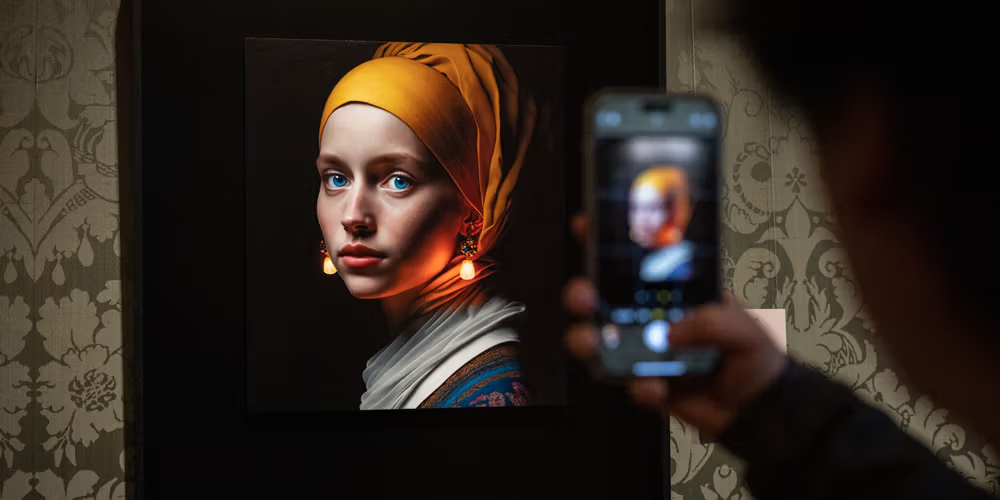
The fair organisers themselves seem to be tacking in the opposite direction. This year sees the first iteration of Zero 10, a section that zones in on digital art, which Art Basel debuted at its Miami fair in December. “We are doing what we can to provide hope, and with an emphasis on the next generations of buyers,” says Angelle Siyang-Le, director of Art Basel Hong Kong. The section’s focus will be on Asian artists, such as the South Korean animator DeeKay (Art of This Millennium gallery), whose playful characters recall a childhood love of video games, and the trio Qu Leilei, Seneca and Tim Yip, whose work fuses artificial intelligence with traditional ink painting (Asprey Studio).


The new generation of buyers is not necessarily comprised of twenty-somethings, Siyang-Le says, acknowledging generally more conservative tastes. “We are promoting cross-collecting. There are people who come from other areas, such as antiques or ink, who are not as familiar with art fairs but are beginning to come to our platforms,” she says.
She and others note the renewed activity around contemporary art in and around Hong Kong, including the appointment of the respected Philip Tinari as deputy director and head of art at Tai Kwun — a cultural complex supported by The Hong Kong Jockey Club — following more than 14 years at Beijing’s UCCA museum. His predecessor, Pi Li, has taken the role of founding director at the Róng Museum in Shenzhen’s Houhai district, part of a mixed-use complex developed by the metals group Tenova Future and set to open in the second half of 2027. Such projects will boost an otherwise beleaguered market, Lam says. “It takes time, but we are heading towards having museums with a voice for China, and for Asia, not just following the west. Now we can start to have more confidence.”
March 27-29, artbasel.com
Find out about our latest stories first — follow FT Weekend on Instagram, Bluesky and X, and sign up to receive the FT Weekend newsletter every Saturday morning