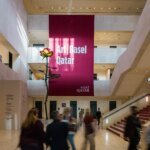
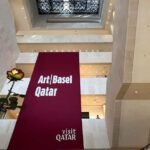
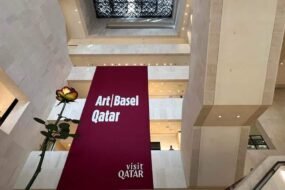
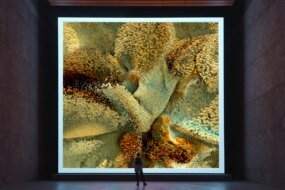
The inaugural edition of Art Basel Qatar, which opened to VIPs on February 3, tested how the art market might operate differently—within an alternative framework and under radically different conditions. A significant number of art professionals and a smaller contingent of international collectors, largely European, descended on Doha, curious to see how this new fair—conceived for the first time by an artist, Wael Shawky, and situated within the rapidly rising cultural capital of the Gulf—would take shape.
On site were prominent industry figures, from Christie’s global president Alex Rotter and its former rainmaker Loïc Gouzer to Fine Art Group founder and New Perspectives Art Partners partner Philip Hoffmann, advisor Maria Brito, insatiably curious international collectors like Alain Servais and Uli Sigg and influential curators such as Hans Ulrich Obrist, Cecilia Alemani, Carolyn Christov-Bakargiev and Klaus Biesenbach. Further fueling the hype, Art Basel’s opening party drew plenty of celebrities, including rapper Swizz Beatz and David Beckham, in one of his very rare—and perhaps only—appearances at art world events.
The fair brings together 87 international galleries presenting the work of 84 artists, more than half of whom hail from the region. As envisioned by Shawky, it was intended from the outset to operate on a smaller scale and with a distinct curatorial focus that would encourage a slower, more attentive encounter with each artist’s practice and symbolic universe, deliberately avoiding the overexposure that leads to saturation and exhaustion at other global fairs.

In an interview with the Financial Times, cultural power player Sheikha al-Mayassa bint Hamad bin Khalifa al-Thani said she initially envisioned the fair as even smaller, with half as many exhibitors, to set the stage for meaningful encounters and education. As Shawky recently told Observer, in traditional art fairs, artworks are often removed from their narratives and contexts and reinserted into purely commercial frameworks. Here, the one-artist-per-gallery format effectively transformed each booth into a micro-exhibition, preserving context and restoring a degree of curatorial integrity in the market-driven environment.
What enabled this more ambitious mise en scène was the strong involvement of the Qatari public sector, represented by the official partnership between Art Basel and Qatar Sports Investments (QSI) and QC+, as well as the central role of the royal family—most notably the Sheikha, who has been the primary driving force and public face behind the entire initiative. In the aforementioned interview, she described Art Basel Qatar as marking “the next phase of our cultural strategy,” a point she further emphasized by calling it “a bold, exciting, and truly unique undertaking” that merges with and amplifies the cultural and artistic ecosystem Qatar has been building over the past 50 years.
The elephant in the room was, of course, how much Art Basel was paid to land in Qatar. Art economist Magnus Resch told Observer that events such as Web Summit—one of the biggest global gatherings in the tech and innovation industry—receive around $13 million to run the event in Lisbon and clearly much more to run it in Qatar. It’s not unreasonable to assume similar dynamics and figures with Art Basel. More significantly, and marking a rare intersection between art fairs and cultural policy, participating galleries also reportedly received support from the Qatari government, with financial assistance covering shipping costs and, crucially, flights and accommodation for one staff member and the artist presented.

Thoughtfully curated across the two venues, the fair unfolded at a fluid pace that allowed space for observation and sustained conversations with gallerists and, often, the artists themselves—creating an ideal environment for institutional acquisitions. The imposed single-artist focus resulted in expansive presentations that functioned less as fair booths than as concentrated surveys of individual practices or specific moments within an oeuvre, offering the kind of discovery and aesthetic reward more commonly associated with a biennial or a museum exhibition. Even in encounters with blue-chip names, visitors often left with the sense of having gained something new.
Delfina Foundation director Aaron Cezar described it as “beautifully composed” and carefully orchestrated—provided, adding with pointed pragmatism, that local buyers are satisfied, a category that implicitly includes the Sheikha herself and the ruling family. “It’s a beautiful format. Time will tell if it works for galleries,” former Art Basel global director Marc Spiegler told Observer, sharing his first impressions.
Curator Alfredo Cramerotti, who has now lived in Doha for two years and serves as director of the Media Majlis Museum at Northwestern Qatar, described the fair as “rather refreshing,” allowing a more engaged and smooth flow for visitors, a more nuanced approach to display for artists and more space and time to present art for galleries. “It’s still an art fair, but I appreciated the effort to pivot the model of the industry fair towards a better fit with the art and culture sector, which usually demands personal rapport and meaningful conversations between the players, beyond the actual matter that is traded, or presented for sale.”
Doha, he noted, has been simultaneously taken over by Art Basel Qatar and Web Summit Qatar, resulting in an interesting overlap of audiences and professionals mingling through the city and discovering the impressive art and cultural institutional framework already present on the ground. “It shows a genuine will to welcome and host all through the layers of Gulf culture—I may be biased (I live here), but I’m positive about what has been taken forward,” Cramerotti said.

“It’s a great fair in a great city,” echoed Philip Hoffmann, who traveled to Doha with a few clients actively looking to buy and particularly appreciated the focused solo presentations. “I think there was a very good turnout of the top art players from Christie’s, Sotheby’s, the big dealers, and there seemed to be an interesting crowd of private collectors from the Gulf region—Abu Dhabi, Qatar, Saudi Arabia and Kuwait. It really works. I was impressed.”
Still, several dealers Observer spoke with questioned whether meaningful engagement with the local collectors they had come to connect with would actually materialize. The Paris director of Italian postwar gallery Tornabuoni joked that the only “local” they had met so far owns a house in Forte dei Marmi, where the gallery also operates, and speaks Italian with a local accent. The gallery presented an outstanding booth dedicated to historical works by Alighiero Boetti, aiming to connect with the region through the artist’s long-standing ties to the Middle East—particularly Afghanistan—and his renewed market momentum over the past year.
Several conversations with local dealers and advisers also pointed to currency erosion in the region and heightened regional geopolitical pressure—most recently, concerns about potential U.S. intervention in Iran—as factors deterring some collectors from attending, with several canceling flights at the last minute.
Overall, the slower pace encouraged by the fair’s format translated into a markedly different rhythm from other Art Basel editions, with very few sales closed during the first preview and VIP days, more works placed on hold and conversations continuing across the floor. Even mega-dealers appeared restrained in reporting transactions. “Nothing firm yet, but there’s good interest,” a spokesperson for David Zwirner told Observer late on the preview day, as the gallery presented three paintings by Marlene Dumas from her Against the Wall series (2009-2010).

Clearly, the first edition of Art Basel Qatar is positioning itself as a long game rather than a guaranteed commercial opportunity. Vincenzo De Bellis (Art Basel’s chief artistic officer and global director of fairs) and Wael Shawky have deliberately avoided measuring success by immediate sales, instead pointing to broader criteria such as relationship-building, institutional engagement and the gradual development of a future collector base. At the core of Wael’s vision is the idea of an art fair that does not separate market and education but understands them as interdependent parts of the same ecosystem.
In many cases, galleries also intentionally chose to hold back from pre-selling works to existing clients, opting instead to test the current potential of the regional market and to observe how this new fair might perform under real conditions. “Qatar’s serious commitment to culture has a trajectory that extends for more than two decades,” Hauser & Wirth president Iwan Wirth told Observer, noting how the gallery has already experienced this firsthand through artist commissions and the institutional framework in Doha. “The partnership with Art Basel has the potential to create a centre of gravity for the art market in the region and to cultivate the wider art eco-system in the city.” Hauser & Wirth is presenting Philip Guston’s late works, produced during a period when his dramatic abstract expressionism shifted toward a dark figurative language that also reflected the social climate of the time. The works have ambitious price tags between $9.5 and $14.5 million.

Still, a small number of works were placed on reserve following a private walkthrough on Monday by members of the Qatari royal family, who were granted the right of first refusal. Several dealers expressed cautious optimism that additional placements could materialize by the end of the week, potentially securing a high-level acquisition with the royal family that would already justify participation. After all, Sheikha Al Mayassa’s acquisition budget for Qatar Museums was estimated by Bloomberg in 2013 at $1 billion—an amount that dwarfs the purchasing power of most Western institutions. Qatar’s acquisitions from the fair will be added to the collection of its contemporary-focused Art Mill Museum, which is due to open in 2030, as well as to the existing Mathaf (Arab Museum of Modern Art), which is planning an expansion.
Among those navigating this long-term positioning, Massimodecarlo is presenting a solo booth dedicated to the late self-taught Chinese-Canadian artist Matthew Wong, featuring viscerally expressive works from the final year of his life. The gallery already has an existing relationship with the royal family, having previously collaborated on a series of portraits by Chinese painter Yan Pei-Ming, now on view at Mathaf as part of its extensive collection—one that visitors had the chance to discover during the breakfast viewing hosted just ahead of the fair’s opening.
Also hoping for high-profile institutional placements—particularly after members of the royal family lingered in visible appreciation for several minutes—was Berlin-based gallery Eigen + Art, which presented the dystopian figuration of Neo Rauch. Grounded in archetype and biography, the booth brought together a group of both large-scale and more intimate works, with prices ranging from $1.1 million to $1.3 million for the major canvases and around $200,000 for smaller formats. Rauch’s epic visual narrations, suspended between internal psychic allegory and historical unease, felt suddenly and sharply attuned to the fragility of the present moment.

Other blue-chip presentations commanding six- and seven-figure price points reinforced the fair’s institutional ambitions. Van de Weghe has staged a full booth dedicated to important works by Pablo Picasso, spanning the artist’s various periods and styles. Acquavella Galleries, charged by the artistic director with presenting the contemporary blue-chip cornerstone Jean-Michel Basquiat, has anchored its booth with a striking central self-portrait from the 1980s priced at $40 million—despite both galleries being well positioned to access top-tier consignments by these artists.
Also on the main floor of M7, White Cube is presenting a sequence of seven fire-gilt bronze bas-relief hands by Georg Baselitz, paired with two paintings from 2019. Gagosian is offering a tightly focused selection of institutional-grade early works by Christo from his Package and Wrapped Objects series of the late 1950s and early 1960s, already articulating the iconoclastic and critical charge that would later define his monumental public projects with Jeanne-Claude and their reflections on monuments, memory and ideology. Also on view is a drawing study for Christo’s long-unrealized Mastaba project, conceived for the desert outside Abu Dhabi and envisioned as his only permanent installation—a late meditation on ephemerality and transcendence.

Nearby, Lisson Gallery has staged a compelling and potentially locally resonant transcultural exchange between ancestral weaving traditions linked to the sacred, bringing to the region the spiritual energy and linguistic practice embedded in the textile tapestries of Colombian artist Olga de Amaral. The booth has six works that explore the possibilities of material, form and abstraction.
On the emerging side, New York dealer Allegra LaViola of Sargent’s Daughters reported an exceptionally strong opening day, thanks to the work of young Pakistani-born artist Aiza Ahmed, currently a resident at Doha’s Fire Station. “The response to Ahmed’s site-specific installation was thrilling! The enthusiasm was palpable, with collectors and institutions from all over the world commenting on the unique format and vision of the fair.” The gallery placed several works priced from $3,500 to $25,000 within the first hours of the fair.
Among the few sales openly reported on the first day, Lehmann Maupin placed two works from its solo presentation dedicated to the politically and memorially charged use of materials and objects by American artist Nari Ward. These included a recent work from Ward’s copper panel series, Still Living, sold in the $80,000-100,000 range, and a new work from his ongoing shoelace series, PRAISEWORTHY, which debuted in Doha and sold within the same price range to a collector in Los Angeles.

One of the works placed on reserve on the first day was a large tapestry by Slavs and Tatars, presented by Warsaw-based gallery Raster. The work articulates Sufi poetic assertions through local bird vocabularies, proposing language as a force that not only shapes reality but also holds the capacity to reconcile it. The symbolic figure of the mythical Persian bird Simurgh resonated strongly with local audiences, opening onto a shared, otherworldly archetypal realm and visual lexicon. This reflection continues in the anthropomorphic ceramic objects False Friends, produced in Mexico, as well as in whimsical metal structures inspired by Arabic characters, which—drawing from Hurufism—bridged bodily and cosmic dimensions.
Regional names received the strongest feedback. Saudi gallery ATHR reported several sales at considerable price points for its presentation dedicated to Dr. Ahmed Mater, including an oil on canvas work that sold for $95,000, alongside two fine art prints on Ilford Smooth Pearl from his Black Stone series (2025), which sold for $55,000 and $60,000, respectively. Works by Lebanese artist Etel Adnan are in a joint booth by Anthony Meier and Waddington Custot, presenting a solo display of small luminous abstract paintings alongside a large, energetic mosaic. Amid ongoing market momentum for the artist, two smaller works had already sold by noon on the first day.

On the Design District side, another long-overlooked Lebanese artist currently experiencing renewed attention, Huguette Caland, appeared at the fair through her estate despite having been announced days earlier on Instagram as presenting with London dealer Stephen Friedman. Booth staff told Observer that Caland will open a new exhibition in May at Lisson Gallery, which has begun working with the estate. The booth featured five distinctive paintings, ranging from the 1970s to the Faces and Places series painted in the latter part of the artist’s career. A horizontal piece densely animated by her intricate patterning hung alongside two medium-sized works that more explicitly staged her sustained exploration of embodiment and disembodiment. All works are priced between $450,000 and $1.5 million, with strong early interest reported.
In terms of curatorial discovery, Helsinki-based Iraqi artist Adel Abidin, presented by Tanit, stands out for his portraits made from Dead Sea salt, which address histories of slavery, erased ethnic groups and structural violence. His approach frames history as an organic medium requiring active engagement rather than nostalgic fixation, reactivating traces that continue to speak in the present. “I examine—through both humor and tragedy—how historical narratives are constructed, rewritten and lived,” he told Observer, explaining how “this is the only way to oppose the erasure of memory, while using my experience of physical displacement as a critical lens through which to question dominant histories and modes of belonging.”
Also among the discoveries was Tunisian-born, Brooklyn-based artist Nadia Ayari, presented by Selma Feriani. Her series of sensually tactile, floral-inspired impasto abstractions blends vegetal elements with investigations of femininity and surveillance. Priced between $30,000 and $45,000 and closely aligned with her recent auction highs, Ayari is set to open her first exhibition back home in Tunisia with the gallery the following week.

Another rising young star in the region worth watching is 27-year-old artist Sarah Al Mehairi, showing with Dubai-based gallery Carbon 12 as the youngest U.A.E.-born and based artist presented at the fair. Featured in the solo booth is her latest body of work, Off-Centered, which investigates the line between painting and sculpture through negative space, architectural unfolding and shifting perspectives. With works priced between $28,000 and $36,000, the gallery reported strong interest and confirmed several placements in collections across Asia and the Middle East, along with notable institutional interest in Al Mehairi’s work.
Meanwhile, established Dubai gallery The Third Line is presenting the work of Qatari-born, London-based artist Sophia Al-Maria, marking a symbolic return to her hometown, Doha, through a body of work that engages with Bedouin identity, family structures and cycles of domestication. Her viscerally expressive drawings are priced between £7,000 and £35,000.

Extremely resonant and provocative are the densely symbolic and psychologically charged oil paintings by Egyptian artist Suad Abdekrasoul, who addresses women’s position within patriarchal systems and the tension between social fear and cosmic belonging. Presented by Egyptian gallery Misr, her large-scale, imposing canvases are reasonably priced between $30,000 and $40,000. The primitiveness of her ambiguous faces suggests the possibility of more fluid metamorphoses with nature, while simultaneously staging tensions and parallels between humanity and animality in behavior. Her figures fluctuate between inner and outer states, unfolding “psycho maps” of “metaphysical bodies,” where psychic instability, corporeal transformation and existential vulnerability collapse into a single visual register.
Established artists from the region with firmly international profiles are being presented by major global galleries. Among them is Perrotin’s solo booth dedicated to a new series of paintings and sculptures by Ali Banisadr, characterized by his familiar psychedelic subconscious density, in which biomorphic, fluid forms seem to emerge directly from the painting’s texture. Conceived specifically for Qatar, this new body of work draws inspiration from the Arabic concept of Al-Kīmiyā, understood not merely as material transmutation but as a philosophical and spiritual process. In this framework, alchemy becomes a means of reconfiguring perception, knowledge and being, offering a way to think through moments of drastic historical shift and instability as they unfold in real time.

Close by, Thaddaeus Ropac is presenting a similarly stunning, intricate epic circle of visual narrations by Kashmir-raised Raqib Shaw titled Echoes Over Arabia, in which myth, memory and psychology converge in a complex syncretic entanglement of historical times and spatial references aimed at revealing the recurring patterns of humanity’s journey and the fragility of existence. “It’s exciting to be part of the first steps of a fair that is set to flourish as it matures and embeds as a regional convening moment,” Ropac told Observer, explaining how, having long-standing relationships in the region with collectors and within the evolving institutional sphere, “it was important to us to participate in the fair,” and they are pleased to be making new connections spanning the wider region as a result of the fair’s draw.
Almine Rech is presenting an intriguing solo by Lebanese artist and filmmaker Ali Cherri, timed with his major New York exhibition. Titled “Becoming Animal,” the selection of mud-formed, archaeological creatures appears to surface from the earth itself, evoking a primordial material connection. Centered on the tension between humanity and animality—and informed by Deleuzian ideas rejecting fixed identities—the new works conceived for Doha explore unstable thresholds between species, bodies and systems of classification. Prices range from $28,000 to $160,000.
At the same time, Art Basel Qatar’s ambition to serve as a premier platform for the broader MENASA region—encompassing the Middle East, North Africa and South Asia—was further underscored by notable solo presentations of artists from farther east in the global hemisphere. Among these, Galerie Lelong and Yavuz Gallery with works by Thai conceptual and contemporary artist Pinaree Sanpitak, whose long-standing poetic and existential investigations center on the vessel as both object and idea. Across the presentation, the vessels emerge as a metaphor for the body, care, balance and transformation, extending her practice’s sustained meditation on containment, nourishment and the quiet politics of form.
Notably, large spatial gaps between the sections and floors of both M7 and the Doha Design District are thoroughly filled with monumental artworks and installations, contributing to the museum-like atmosphere. At the entrance to the M7 second-floor galleries, a striking installation by Arte Povera master Jannis Kounellis—originally conceived as a site-specific work for the church of San Lazzaro in Venice in 2003—is being offered by Cardi directly from the artist’s estate in the six-figure range. Confronting it on the floor was an equally suggestive multi-part sculpture of fluid forms crystallized in black-glazed ceramics, Elephant Necklace Circle by Lynda Benglis, presented by Pace Gallery. Nearby, Kamel Mennour presents Claire Fontaine’s iconic multilingual neon installation Foreigners Everywhere, which, as Mennour himself noted, echoed its resonant presentation at the Arsenale during Adriano Pedrosa’s 2024 Biennale, whose title it inspired.

Other spaces across the floors are hosting major video works and multimedia installations—often within museum-grade immersive environments—such as Bruce Nauman’s Beckett’s Chair Portrait Rotated (2025), presented by Konrad Fischer Galerie, or Otto Piene’s mesmerizing light installation Light Ballets, shown by Sprüth Magers. Inside M7, Lia Rumma is presenting a projection of Shirin Neshat’s latest video work, produced in 2025 as the first chapter of a trilogy titled Do You Dare, co-produced on the occasion of her exhibition coming to Palazzo Marin during the Venice Biennale. The presentation clearly targeted a museum-level acquisition for an artist who already had a major survey at Mathaf in 2015—much like figures such as Etel Adnan or Mona Hatoum had a decade ago—affirming the institution’s role in pioneering and shaping much of the contemporary art discourse in the region, often well ahead of Western institutions engaging those names at a comparable scale.
If successful, the first edition of Art Basel Qatar will serve as proof that a different way of presenting and mediating art within a commercial framework is possible. Its more curatorial, reflective approach positions the fair not just as a platform for buying and selling but also as a cultural bridge between the region and the international art world—situating each practice in context through a site-specific, community oriented and educational lens.
As Magnus Resch put it, “Art Basel Qatar isn’t just a smaller fair; it’s a structural experiment.” By reducing scale, lowering risk for galleries and embedding the fair in a long-term cultural strategy, it shows that art fairs don’t necessarily have to be high-risk marketplaces, leaving more space for quality and experimentation. “Change the economics and the context, and the entire format changes,” Resch added. Still, time will tell whether this model will be economically viable for galleries, given the market realities of today’s increasingly fragmented system. It may indeed be the opportune moment to rethink art fairs as for-profit, invitation-based biennials operating at the intersection of the art trade and cultural policy frameworks.

More in Art Fairs, Biennials and Triennials