Decisions over which artworks are — or are not — hung in government buildings can cause distress. Consider the UK’s then foreign secretary David Lammy’s removal of a portrait of Queen Elizabeth II from the Foreign Office last year, installing a “pan-African flag” by British-Ghanaian artist Larry Achiampong instead, which sparked a rather spurious culture war in miniature.
Perhaps politicians could take some guidance from the diplomats who serve under them. After all, they have been tactfully hanging works in embassies for centuries.
I’ve seen art’s soft power in action at embassy receptions where works range from the magnificent to the downright weird. On one visit to a foreign ambassador’s London residence (country redacted) I spotted a fabulously kitsch painting of the nation’s former monarch, executed in a style best described as “psychedelic medley”. It had been carefully hung in the most inconspicuous corner of a little-used stairwell. Very diplomatic.
The UK organisation that oversees art in embassies, consulates and ministerial departments is the Government Art Collection (GAC), which holds some 15,000 works, while in the US the Foundation for Art & Preservation in Embassies (FAPE) serves a comparable purpose. Most countries have something similar and each has to budget according to a fluctuating art market, deal with strident public opinion and account for the varying tastes of officials.


“You don’t always just want brown 18th-century pictures,” says Sir Peter Ricketts, former permanent secretary to the Foreign and Commonwealth Office and British ambassador to France between 2012 and 2016. “As you go up the hierarchy you can get access to more interesting pictures,” he adds, recalling his glee scanning the racks at the GAC warehouse. “I saw all sorts of fantastic things like, for example, a Constable. And I’d say, ‘Oh I’d love that’. They’d say, ‘Oh, no, no, that’s going to Number 10’.”
It only really gets political, observes Ricketts, at the top level. For instance, when a new prime minister puts up a portrait of their hero or heroine (or takes one down, as in the case of Sir Keir Starmer’s removal of a portrait of Margaret Thatcher). Similarly, Ricketts notes, in the US “Churchill’s bust seems to be moved in and out of the Oval Office and headlines each time.”

Not all embassies are equal, he says. “Paris is probably the apex of British embassies in terms of the art in it.” The ambassadorial residence, Hôtel de Charost, on rue du Faubourg Saint-Honoré, was bought in 1814, when the Duke of Wellington was the incumbent ambassador. “It came with the furnishings, furniture, clocks and gilt objects everywhere, so it’s retained that early 19th-century flavour,” Ricketts says.
The pictures include a James Tissot and a Jacques-Émile Blanche portrait of Queen Alexandra. But it is a contemporary work that sticks in Ricketts’ memory. “There was one that was slightly more risqué and gave rise to a few raised eyebrows on the part of French of a certain age and this was a Grayson Perry. It’s called ‘Map of Nowhere’, and it’s famous and it’s wonderful. However, it does contain some relatively graphic images of the male anatomy. I thought, sometimes, of putting a Post-it note over that particular part of the picture.” It now resides in the Ministry of Justice.


Works often provide cultural bridges between countries. Ricketts notes that the British ambassador’s residence in Copenhagen features portraits of James I and his wife, Anne of Denmark. Similarly, it’s commonplace to find local landscapes painted by visiting British artists. “It can help tell the story of Britain’s engagement with countries around the world,” he says.
The cultural traffic goes both ways. Foreign embassies in London possess many treasures. The French embassy, Ricketts says, has a “very fine Walter Sickert portrait of Degas” — an example of a British master paying tribute to a French one.
In the hit Netflix drama series The Diplomat, about a fictional US ambassador to the UK, the decor of her London residence, Winfield House, is equated to that of a “granny”. In fact, US embassies feature works by blue-chip contemporary artists. “FAPE’s original print collection is our oldest programme,” notes director Jennifer Duncan. “It began in 1989, when Frank Stella donated ‘The Symphony’ in an edition large enough for a print to be sent to every American embassy.” Since then, the roll call of artists and architects who have donated works includes Frank Gehry, Jeff Koons and Ed Ruscha. The 2025 gift is an abstract etching by Rashid Johnson.

A balance needs to be struck between celebrating a country’s artistic traditions and promoting its new talent. “An ambassador should be cautious about imposing changes on the art already hanging in an embassy,” says Tore Hattrem, Norway’s ambassador to the UK, adding that, in his view, a residence should have more historical works, while the chancery should showcase “art of our own time”. One of Hattrem’s favourite pieces in the Norwegian residence is a lithographic self-portrait by Edvard Munch with “a striking, psychological dimension”.


At the embassy of Japan in London, Shuji Maeda, minister for public diplomacy and media, walks me through corridors and rooms full of calligraphy, cherry blossom and landscapes, which include a vast 20th-century composition of snowy mountains by Chuichi Konno. “For visitors like you, we want the embassy to have the feel of the environment or atmosphere that Japanese objects or Japanese scenery might create. These subjects tend to be apolitical,” Maeda says.


Some of the works are gifts from visitors. But not all are put on display. What would happen if David Hockney, an admirer of Japanese printmaking, donated a work? “We’d like that. That would get hung,” says Maeda, smiling. “But diplomats are not meant to talk about hypotheticals.” Wabi-sabi, the Japanese philosophy of finding beauty in the imperfect and everyday, informs much of the collection, but two fierce woodblock prints of mythological figures make me pause. Gifted by London-based Japanese artist Nana Shiomi, in gratitude for the embassy’s assistance, they “express the primal, animistic power inherent in the Japanese people and culture”, she says.
“We’re diplomats so we shouldn’t be too provocative,” says Kristina Miskowiak Beckvard, Danish ambassador to the UK, talking to me in her London office overlooking Cadogan Place Gardens. Beauty is fine, she observes, but ambassadors don’t want discussions on green energy or defence spending distracted by works that give off “a very sharp political statement or a sexual statement”. Works should be seen and not heard, she says.
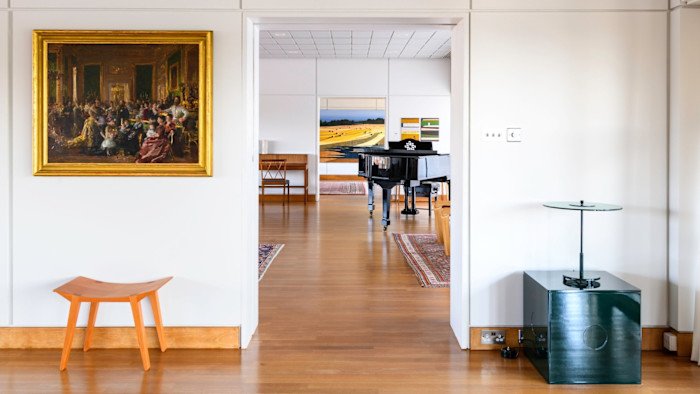
The Danish embassy is, arguably, the gold standard for art diplomacy. The building on Sloane Street — a stark architectural grid of grey modernism by Arne Jacobsen — is a work of art in itself. Inside the ambassador’s residence on the top floor, both modern and 19th-century works, including portraits of British royals by the Danish painter Laurits Tuxen, have been sourced from the Danish Arts Foundation’s collection.
Meanwhile, a selection of colourful contemporary pieces from the New Carlsberg Foundation collection — including a sculpture of entwined lifebuoys by Elmgreen & Dragset — are displayed in the chancery below. One embassy, two collections. The guiding principle is they “should be branding Denmark as the design nation we are”, says Beckvard.


Displaying art within an embassy needs to factor in the function of each particular space, notes Johanna Lassenius, a curator with the Danish Arts Foundation. “Is it the entrance, which gives visitors a first impression, but where they don’t stay very long?” she says. “Or is it the dining room, where they might sit for hours and have many different conversations?”
Provincial rather than international politics often shine an unwanted light on the GAC, as the debacle at the Foreign Office attests. Eliza Gluckman, the GAC’s director, declined to be interviewed for this piece. But two key donors to the collection, the American film producer Sybil Robson Orr and her husband Matthew Orr, a British investor, noted the need to move the holdings away from art by “older white male painters”.
Pondering all this inclusive curation and cultural ice-breaking, Ricketts sums up the pros and cons of embassy art. “It is part of British soft power, it’s normally fine, occasionally it can be a little bit embarrassing,” he says. “But it’s also very striking how many people completely ignore the art on the walls.”
Find out about our latest stories first — follow FT Weekend on Instagram, Bluesky and X, and sign up to receive the FT Weekend newsletter every Saturday morning