A version of this article originally appeared in The Back Room, our lively recap funneling only the week’s must-know art industry intel into a nimble read you’ll actually enjoy. Artnet News Pro members get exclusive access—subscribe now to receive the newsletter in your inbox every Friday.
Many artists today are rethinking what gallery representation should look like, thinking about what they actually want: not just sales, but also help with copyrights, visibility, and various kinds of partnerships in an increasingly complex creative landscape. What does this portend for the art market?
The More the Merrier?
Signing with a single major gallery in a major city was once seen as a career pinnacle, but more flexible co-representation arrangements are on the rise. Of course, joint artist representation isn’t necessarily new. Star artists have long been able to work between different dealers. Jeff Koons, for instance, showed with rival megas Gagosian and David Zwirner before decamping for Pace in 2021. (At Frieze New York earlier this month he showed with Gagosian: it’s hard to keep track.)
But Hauser and Wirth’s 2023 launch of its Collective Impact initiative signaled a sea change. Since then, it has co-represented several on-the-rise artists with the smaller galleries that gave them their start, including Ambera Wellmann with Company Gallery and Uman with Nicola Vassell.

Ambera Wellmann, Ferox (2024). Courtesy the artist, Company Gallery, and Hauser and Wirth.
Many other artists are foregoing galleries entirely, joining artist agencies, or even representing themselves. But there is a generational divide in what they are looking for.
“Emerging artists are more business savvy these days,” said Marine Tanguy, founder and CEO of MTArt Agency, one of the first visual art-focused talent firms. “They ask better questions about contracts, and I welcome that.” She pointed out that Hauser and Wirth’s Collective Impact scheme is driven by artists under 45. Younger artists are looking for credibility, she added, “but more established artists want visibility, and they are coming to us to expand their reach outside of the traditional art world.”
’Gram Gains Wane
The rise of social media in the last decade, especially Instagram, is the most obvious factor in artists choosing to chart their own course. Artists have been able to build direct relationships with collectors and reach a large audience by themselves, without the expertise/connections of dealers.
Tanguy noted that social media’s reach has catalyzed an expansion in art buyers. Just 20 years ago, the “typical” collector was, “white, male, and over 50,” she said. “Now that is radically different.”
Yet over the past few years, social media’s power has declined, according to Jade Mitchell, the founder of Blank Canvas Coaching, a career coaching organization for creative professionals.
“Social media platforms now prioritize different styles of content and operate on a more pay-to-be-seen model, making it much harder for artists to gain visibility without investing in advertising,” she said. Nevertheless, buyer behavior hasn’t shifted in the same way, she added. “There is still strong demand for discovering and buying art online.”

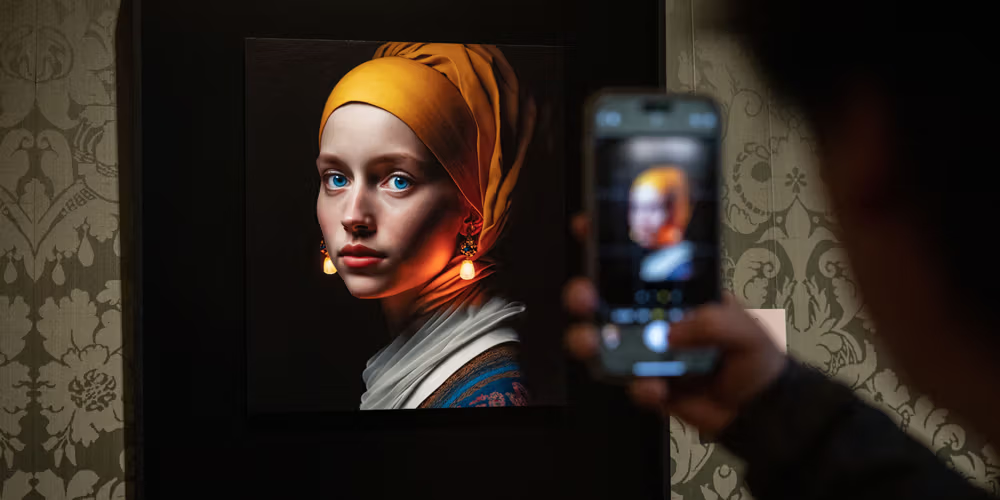
Social media influencer Chixpudding poses for a selfie in front of A.I. images of kittens during a press preview of the “CUTE” exhibition at Somerset House on January 24, 2024 in London. Photo: Leon Neal/Getty Images.
This highlights the need for new models that let artists reach audiences and sell work independent of gatekeepers or social media algorithms, Mitchell said. On June 12, she will host a free virtual workshop in partnership with Art Market Mentors to help artists do just that.
The Right Rights
As Instagram’s influence ballooned, brand partnerships proliferated. Galleries largely run off of a business-to-consumer (B2C) sales model, as Tanguy put it, but in the early 2010s, business-to-business (B2B) opportunities with mainstream brands offered new and lucrative revenue streams for many artists. They also presented new challenges.
“If someone approaches an artist to license the rights to their work, only the biggest galleries may have staff that are equipped to deal with that kind of request,” she said, adding that MTArt has handled public art, digital partnerships, and brand collaborations. Launched in 2015, her agency has done deals with global event and entertainment brands like Apple TV and FIFA World Cup. The firm is now valued at around £35 million ($47.2 million), she said, and received backing from collector Frederic Jousset and tech entrepreneur Saul Klein, among others.
Rights management looms even larger in the age of A.I. since there is minimal regulation and enforcement around the use of creative media to train models. Even a massive company like Getty Images “can’t pursue all the copyright infringements that happen in one week,” its CEO, Craig Peters, told CNBC this week. (The image-licensing company is in a years-long legal battle with Stability A.I. over claims of image scraping by the tech firm for its text-to-image generator.)

Marine Tanguy attends the MTART Agency’s seven-year anniversary party on June 23, 2022 in London. Photo: David M. Benett/Dave Benett/Getty Images for MTArt Agency.
“There’s no doubt that we need better regulatory frameworks,” said Tanguy, who is speaking about art, authorship, and A.I. at the debut edition of SXSW London next week. Until those frameworks are in place, she stressed, artists need to have contractual protections for their work.
The Bottom Line
Like the internet before it, there is a lot of unnecessary (though understandable) fear around A.I. in the art world. The backlash to Christie’s first dedicated A.I. auction in March perhaps underscores the lack of nuance in conversations about the digital frontier of art. Plenty of artists are using A.I. as an administrative tool, Mitchell said, while others are using it to explore the ethics and limits of the technology itself as a part of their practice, according to Tanguy. Either way, though, it’s changing how artists are working, and some dealers may need to play catch up.
However, there remains unquantifiable value in gallerists’ expertise, networks, and ability to contextualize an artist’s work. These factors can play a crucial role in building credibility and long-term career value. “The challenge—and indeed opportunity—lies in finding hybrid models that preserve the integrity and support of these trusted voices,” Mitchell said, “while offering artists greater autonomy, transparency, and direct access to the people who love what they create.”