[ad_1]
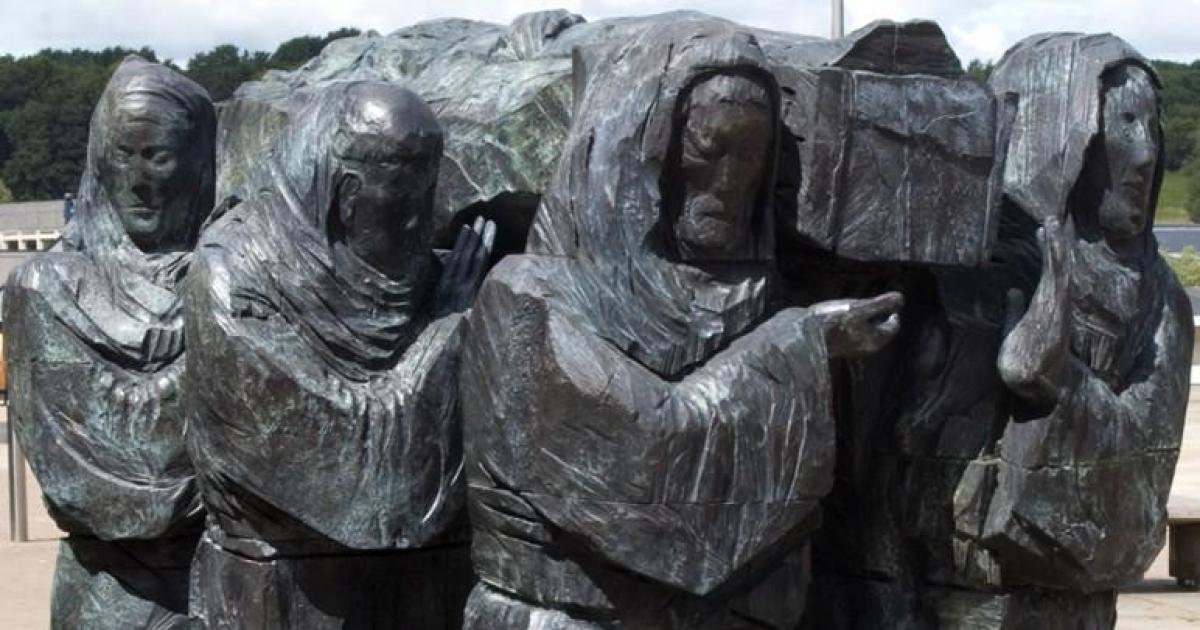
The Journey, by County Durham–born sculptor Fenwick Lawson, is a bronze artwork in Durham’s Millennium Place showing six monks carrying the coffin of St Cuthbert.
It depicts the moment in 995 when the monks brought Cuthbert’s remains to the site where Durham Cathedral now stands, a key moment in the city’s origin story.
The sculpture began as a wooden work carved in the late 1990s from seven elm trees.
Lawson’s original piece, still housed in St Mary’s Church on Holy Island, shows the monks straining under the coffin as they leave Lindisfarne to escape Scandinavian raids.
He used chainsaws and hand tools, producing sharply cut forms and pronounced facial features that emphasise the physical effort of the figures.
When it was exhibited at Durham Cathedral in 2004, the wooden Journey attracted significant public interest and led to calls for a permanent version in the city.
In response, the Journey Appeal was set up to fund a bronze cast. Chaired by the then Dean of Durham, the Very Reverend Michael Sadgrove, the campaign ran for nearly two years and aimed to raise £250,000.
Donations came from local events, community groups and individuals, alongside larger contributions from Durham City Council and regional media.
A major gift from Penny Richardson, in memory of her husband Alderman Norman Richardson, a former mayor of Durham, helped the appeal reach its target.
Once funding was in place, the wooden original was sent to an Edinburgh foundry, where it was used to create the bronze version, around 1.8 metres high.
The bronze Journey was installed in Millennium Place, next to the Gala Theatre and Clayport Library, in 2008 and unveiled by the Princess Royal. It was intended as a focal point for a developing cultural area in the city centre.

Since then, it has become a familiar feature of the square and a regular reference point in local discussions about public art and Durham’s identity.
The choice of location has, however, drawn criticism, with some residents and commentators arguing that a sculpture about monastic devotion and pilgrimage would be better placed in or near the cathedral precincts than among bars and restaurants.
Fenwick Lawson’s background helps explain why this subject and story appealed to him.

Born in South Moor, near Stanley, in 1932, he grew up in a mining community and later studied at Sunderland College of Art and the Royal College of Art in London.
He returned to the North East to teach and to base his practice, developing a career focused on religious and figurative sculpture in wood and bronze.
His works include pieces for Durham Cathedral and churches across the region, and he became known for exploring themes of faith, suffering and endurance.
Lawson died in January at the age of 93, leaving The Journey as one of the most visible examples of his work in his home county.
[ad_2]
Source link