[ad_1]

It has been three
years since the CIMA Awards 2022, organised and conducted with grace and
bravery in the final throes of the pandemic. At that time, the artistic
community, reeling in the aftermath of the deadly disease and the gradual
re-entry into normal life, found ways to band together. With the support of the
Centre of International Modern Art, the vision and work of more than 180
artists found their way to the larger community of art lovers, culminating in
an edition of the Awards that will be remembered for years.

Now, three years
later, “following the final exit of the pandemic, the artistic community of
India has finally settled down, and we have progressed to the CIMA Awards
2025,” says Rakhi Sarkar, director, CIMA, and managing trustee, Art &
Heritage Foundation. Her words resonate deeply the moment one steps through the
doors of the Academy of Fine Arts — one of the two venues showcasing the
artworks submitted for the CIMA Awards 2025.
CIMA has long been a
beacon for artistic discovery, but this year, an unmistakable sense of the
extraordinary pervades the experience. Even the pathway leading to the entrance
of the Academy building, associated for decades with artistic excellence, seems
charged with an air of anticipation, setting the stage for an exhibition that
promises to challenge conventional notions of what defines great art.
The triennial CIMA
Awards have expanded significantly since their inception a decade ago, both in
reach and influence. “The awards arose from the need to talk about India
and how contemporary artists related to it,” said Rakhi Sarkar. “In 2015, after
22 years of running CIMA, we felt the need to introspect; were we really
serving the needs and prospects of this vast country, with its ancient history,
legacy, challenges, exceptional complexities and diversity? Not really. We were
merely serving the predilections of an urbanised populace and overlooking the
vast reservoir of talent going largely unnoticed in other parts and pockets of
the country. It was from this imperative that the idea of CIMA Awards was
born.” Since then, the awards have grown into a crucial platform, reshaping the
discourse around contemporary Indian art and putting the spotlight on artistic
voices that might have otherwise remained unheard.
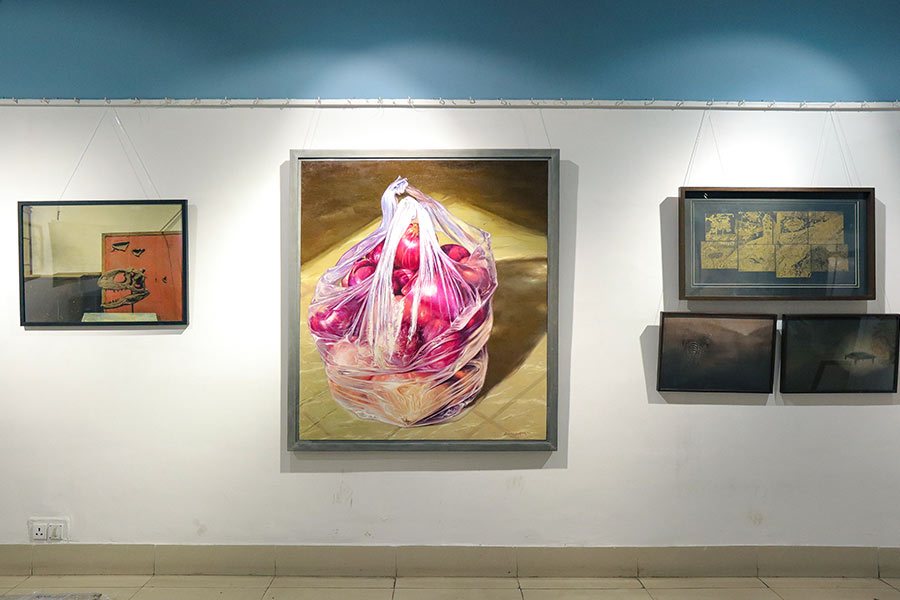
The 2025 edition of
the CIMA Awards brings together the works of more than 200 artists from 22
Indian states, offering a diverse and expansive showcase of contemporary
talent. Around 213 artworks — including paintings, sculptures, graphics,
installations, digital, and new media art — are being exhibited across two
venues: the Academy of Fine Arts (January 31 – February 18) and CIMA Art
Gallery (January 31 – February 28).
Crucially, the awards
place no restrictions on educational background or formal training, ensuring
that self-taught artists have an equal opportunity to participate. While
representation remains an area for growth — Rakhi Sarkar had noted that in
2022, over 75 percent of participants were male — the gradual and steady
widening of the awards’ scope has led to a meaningful shift. This year, a
significantly higher number of women artists are being exhibited, marking an
essential step toward greater inclusivity and the recognition of true creative
excellence.
Academy of Fine
Arts: Natural interaction between space and art

The first hint of this
becomes apparent in the thoughtful curation of the exhibition, particularly at
the Academy of Fine Arts, where the venue’s old-world charm provides a fitting
backdrop for the nature of the artworks on display. A striking feature is the
artists’ inventive use of diverse materials and their strategic engagement with
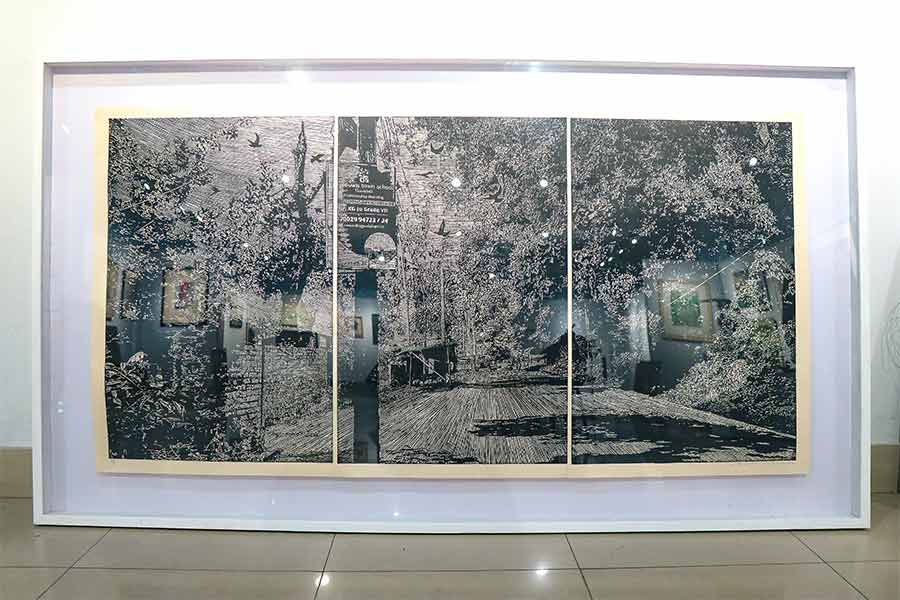
the space to present their works. Whether it’s Somen Debnath’s powerful
sculptural installation titled Reformation (chainsaw carving on wood) or
Chhering Negi’s stunning Rear Window (woodcut, set of 16), visitors are
immediately drawn into an immersive encounter with the artists’ visions from
the moment they step into the venue.

The devastation of the
pandemic — particularly its deepening of poverty and social exclusion — emerges
as a powerful theme in Sanjay Kumar Yadav’s COVID-19 (etching).
Positioned intentionally within a distinct section of the Academy of Fine Arts,
the piece, with its stark visuals of disease, grief, loss and helplessness,
almost takes the viewer by surprise. The dialogue between space and artwork is
seamless; the venue’s sparse, expansive interiors not only accommodate but
amplify the themes and emotions embedded in the works on display.

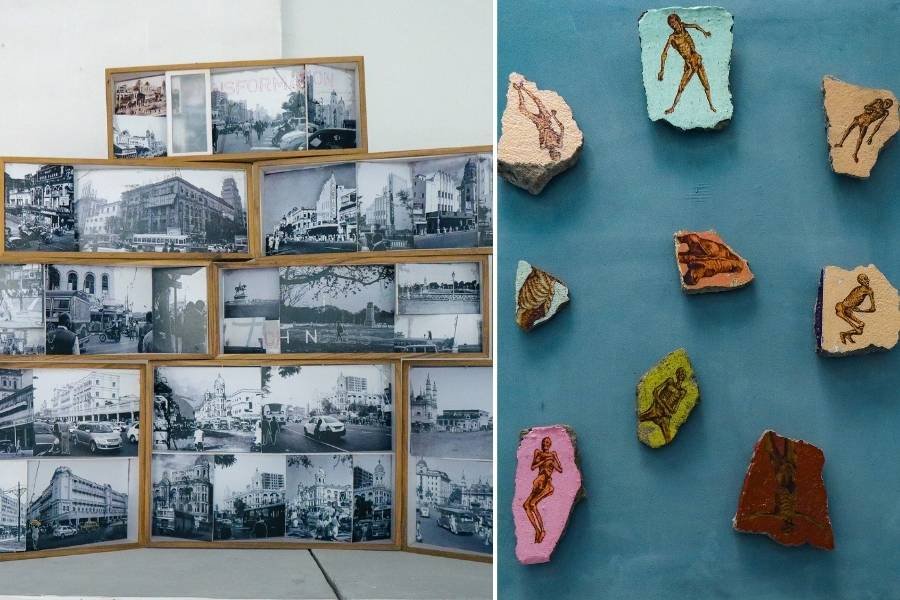
In one room, Asif
Imran’s Mahanagar (The City) – Period Changes (digital print and drawing
assembled in 3D boxes) compels the viewer to reckon with the unrelenting
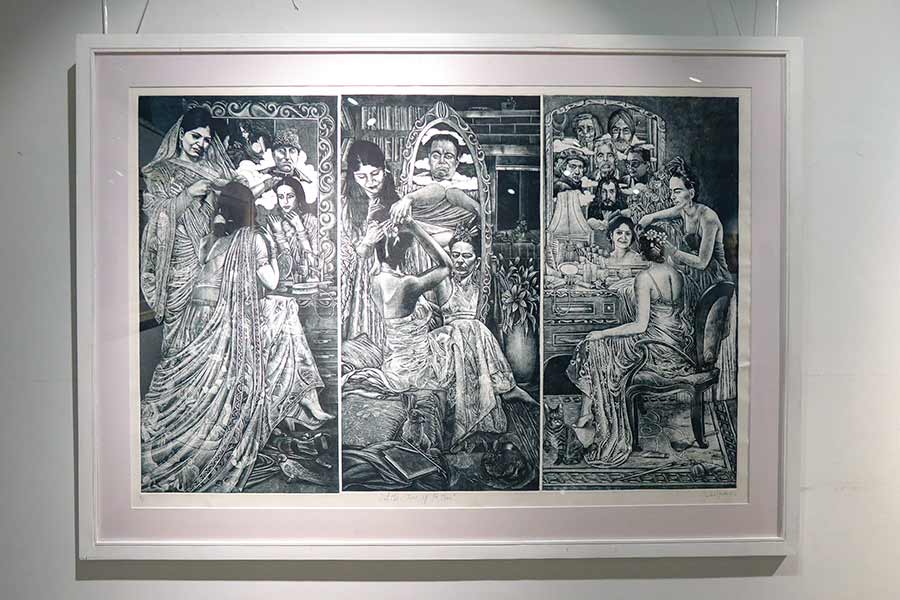
passage of time. Elsewhere, Nilmoni Raha’s Home Sweet Home (photographic
montage) and Sushma Yadav’s Let Me Dress For Mine (etching, triptych)
draw us uncomfortably close to questions of intimacy — our homes, our minds,
and the very essence of our personhood. Here, the haunting spectres of war,
religion and death intertwine with struggles of identity and self-perception,
creating not just a space for reflection, but for an urgent, unsettling
reckoning.
CIMA Gallery:
Contemplative quiet and hard questions
The transition from
the resonant, immersive environment of the Academy to the contemplative quiet
of CIMA Art Gallery feels seamless, though the themes explored here remain just
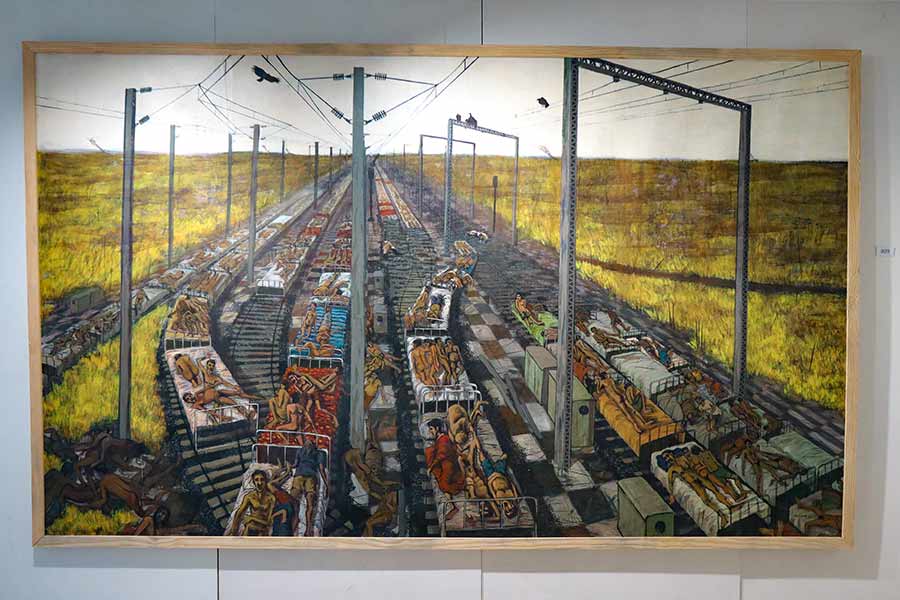
as pressing. While Anshul Maheshwari’s Guardians of the Two Worlds
(brass and iron sheet) echoes the gallery’s more reflective atmosphere, other
works introduce necessary disruptions to this tranquillity. Viewers are met
head-on with a refusal to turn away from the question of what constitutes
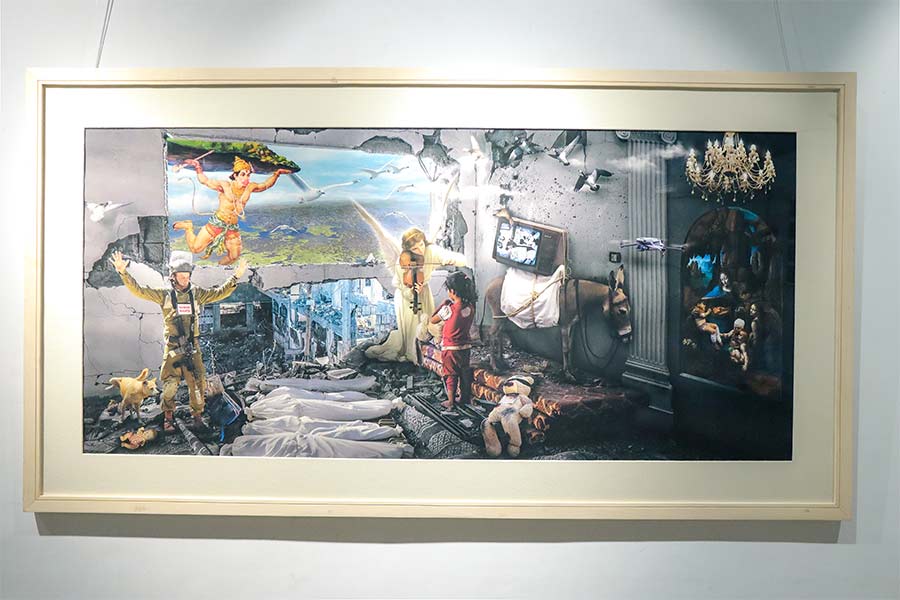
suffering in Kamalendu Paul’s Tragic Circus (acrylic, charcoal and
Fevicol). Visuals of human bodies — are they families? Are they all islands?
Are they both? — strewn across beds on railway lines compel one to confront the
blurring of boundaries between the ideas of home, destitution, danger, open
spaces, claustrophobia, public access and family, all of which constitute
running themes in the daily lives of most Indians.

Abhijit Debnath’s Temporary
House (drawing on paper, cloth, gamchha, lungi, object
sculpture, video and sound), Suman Kabiraj’s Trap (installation of
cotton threads, wood, painted glittered objects and small hard objects),
Suvojit Roy’s It’s Raining by Collapsing House (wall painted by black
japan and installed with tin, motor pump, bamboo and used utensil material) and
Rimi Adak’s Untitled (mixed media on canvas) are among those that
unsettle, reminding us how easily serenity can slip into complacency —
challenging us to stay engaged, questioning, and aware.
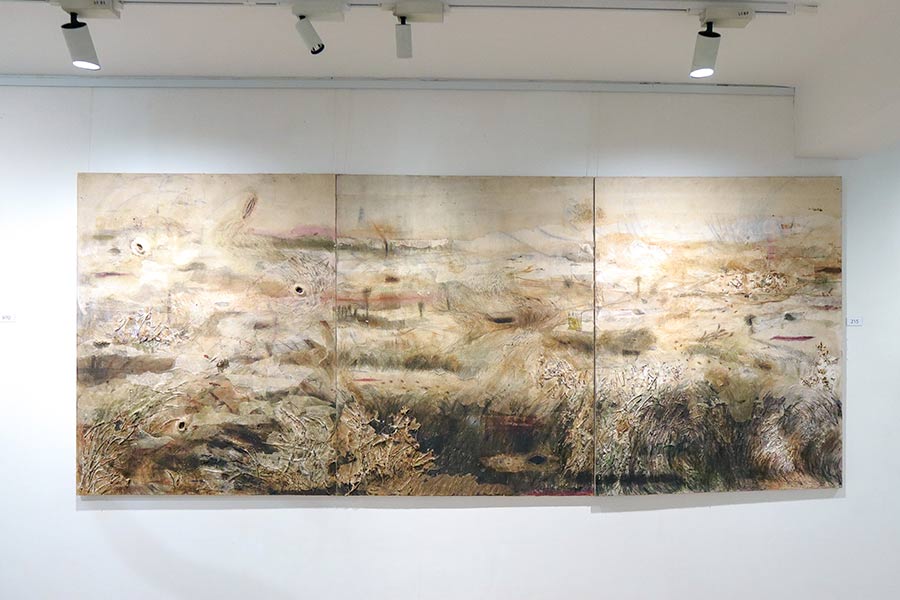
Perhaps this, then, is
the most significant takeaway from a CIMA exhibition that encapsulates the vast
multiplicities of India’s artists: art, along with the spaces it occupies, has
a way of posing unexpected questions — and in contemporary times, those questions
often lead to answers that are anything but comfortable.
The CIMA Awards
show is open 11am – 7pm at CIMA Gallery till February 28, and 12pm – 8pm every day at the Academy of Fine Arts till February 18
[ad_2]
Source link