[ad_1]
In the first room of “Martin Puryear: Nexus” — a full-career survey of the sculptor’s work at the Museum of Fine Arts in Boston — is a set of white antlers, about 12 feet wide, mounted like a hunting trophy on an inverted wooden cross. It recalls the Irish elk, an ice age species whose males produced increasing amounts of testosterone to grow larger racks, allowing them to better compete for mates. Unable to carry the extra weight, the story goes, the breed became extinct.
But Puryear’s antlers, cast from lightweight aluminum and painted white, could practically float away.
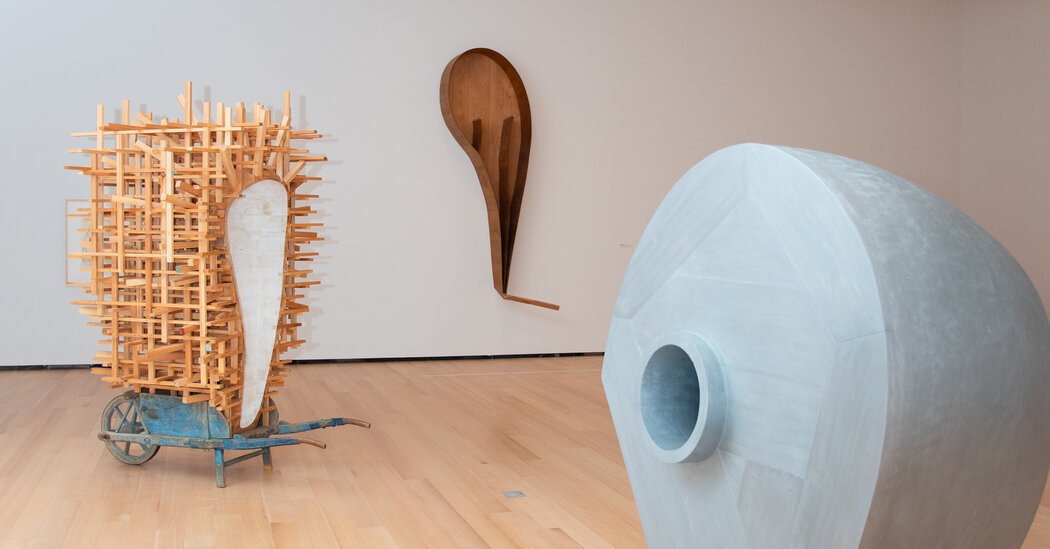
The work is an elegant introduction to the contradictions in the oeuvre of this artist. Across the 50-odd works in “Nexus”— almost 30 sculptures, along with a rich selection of rarely shown prints and drawings — shapes soar and sink, suggest ponderous weight and lightness, shift between pure abstraction and references to the natural, cultural and political worlds and to art history. His ability to hold all of these incongruities in tension has secured him a place as one of the leading sculptors of his generation.
Though Puryear has worked in many materials — cast iron, rawhide, bronze, marble and glass appear in “Nexus,” and he has used brick, stone and thatch in his public artworks — many of his sculptures result from his long negotiation with wood. It’s a medium that is notoriously finicky, bending and warping in response to changes in temperature, humidity and the way it is cut. It has a mind of its own.
Puryear has spent a career learning its properties. Lessons were gleaned from village artisans in Sierra Leone, who worked without power tools to outfit the school where Puryear taught during his stint in the Peace Corps, in the mid-1960s, and from a master furniture maker whom he met in Sweden while there pursuing a master’s degree in printmaking. His lifelong study of French, Japanese, Korean, Scandinavian and West African artisans is likewise distilled in his elemental forms.
This knowledge is on full display in works like “Self,” 1978, which appears to be a solid black mass, smooth as a river stone. But look closely and you see it is pieced together out of strips of red cedar and mahogany, the seams so precise as to be almost invisible. (In “Alien Huddle,” 1993-95, he leaves the wood’s grain visible, cutting and joining elements in a way that turns the whole into a shimmering, scintillating, bulbous orb.)
The particular curve in “Self” recurs throughout Puryear’s work. When I asked him about it during a visit to his studio this summer, he wordlessly ran his hand from the base of his neck to the swell of his skull, a gesture that seemed to capture the way he sees sculpture in terms of a body’s encounter with it, including his own. (It is no coincidence that many of the sculptures on view in Boston are human-scaled, including “Self,” which is 5 feet 9 inches tall.)
The shape is put to seemingly endless uses. In “Bower,” 1980, fashioned out of thin strips of spruce and pine bent into a lattice frame, it suggests an enclosure. In “Big Phrygian,” 2010-14, it breaks near the top in the manner of the red cap used by 18th-century Haitian and French revolutionaries. “Aso Oke,” 2019, is woven out of rattan and twine and then cast in bronze. It is inspired by a hat worn by the Yoruba people at ceremonial occasions, but takes on an architectural feel as well.
The curators of “Nexus,” Emily Liebert at the Cleveland Museum, where the show will travel, and Reto Thüring, formerly at the MFA Boston, have chosen to foreground Puryear’s deep interest in the natural world. He has long been fascinated with the naturalist and ornithologist John James Audubon, whom the art historian David C. Driskell suggested was biracial in his landmark 1976 exhibition “Two Centuries of Black American Art.” (Although Audubon was himself a slaveholder and his racial identity has never been fully settled, Driskell’s conjecture has inspired Black artists in the years since.) Puryear also trained in falconry. These interests, we are told, go some way to explaining the birdlike shapes of works such as “On the Tundra” — both a black patinated bronze version from 1986 and a second, pure white marble version from 2022.
The insight is revelatory, and soon you will be seeing birds everywhere in “Nexus.” For example, “Bask,” from 1976, a 12-foot-long, dark-stained curved wedge lying horizontally on a low plinth, might remind you of a seal sunning on a rock or the hull of a capsized boat, but it takes on new meaning when you recognize its echo of Brancusi’s “Bird in Space” (1928).
But don’t let such resemblances distract you from the way Puryear’s shapes constantly shift, like a game of duck-rabbit: What may read as avian from one angle might look like a woman’s elaborately coifed head from a West African sculpture, or a bust by Matisse, from other vantages.
Puryear has spoken in past interviews about feeling out of step with, and perhaps even sidelined by, the focus in the 1970s and ’80s on minimalism and conceptual art. While his peers were outsourcing the fabrication of their work and taking up industrial, modular forms, Puryear leaned into the handmade, creating abstract objects that were too often understood as purely formalist exercises in craft.
But when he was selected to represent the United States at the 2019 Venice Biennale, two years into the first Trump administration, he filled the pavilion with sculptures that responded quite directly to what he saw as a political crisis. That was where he first showed “Hibernian Testosterone,” the antler piece; in that context, the reference to the dangers of (literal) toxic masculinity couldn’t have been clearer.
Another work shown there, “A Column for Sally Hemings,” honored the young woman who bore six of Thomas Jefferson’s children, and who was long referred to as his mistress despite her enslavement. A smaller version, made in 2021, is on view in Boston. A fluted marble column, a feature of Jeffersonian architecture, tapers as it rises, suggesting a woman’s skirt. Atop, like an elegant neck and head — or a graceful bird — is a cast-iron spike topped with a ring and bolt, an almost violent contrast to the whiteness of the stone.
The spike descends into a hole in the marble without actually touching it. With this subtle gesture, it is as if Puryear has both signified the realities of Heming’s existence and conferred on her an autonomy she never experienced in life.
“I think making art for art’s sake tends to be my focus if you want to put it in the bluntest terms, but reality, including social reality, intrudes a lot because I am alive,” he said during my visit to his studio, when I noted the way such work encodes histories of power. “I have a history — a personal history, and I am part of a larger history — and I’m watching things unfold.”
His engagement with the past illuminates “Some Lines for Jim Beckwourth,” from 1978, where he transforms animal skins into rawhide strings arranged like a musical staff. It’s a celebration of the 19th-century fur trapper, born to an enslaved mother and a white slave-holding father, who had deep ties to the Crow Nation. They surface in the wooden slip case he created for a special edition of the 1923 novel “Cane,” by the groundbreaking Harlem Renaissance writer Jean Toomer. Four different woods represent different skin tones — a fitting tribute to Toomer’s vignettes reflecting the diversity of African Americans. And they emerge in many references to movement and migration in the show, including “Confessional” (1996-2000), which looks like the top of a covered wagon.
One comes away from “Nexus” with the understanding that the more you drill down into Puryear’s shape, material and technique, the more his entanglement with the world reveals itself.
Martin Puryear: Nexus
Through Feb. 8, 2026, Museum of Fine Arts, Boston, 465 Huntington Avenue; 617-267-9300, www.mfa.org.
[ad_2]
Source link